Articles and case studies on diagnosing what is actually limiting an individual, a team, or an organization, and what changes once the right problem is on the table.
Quick Answer: These are real outcomes from Scott Fishman’s coaching and consulting work, not composite examples. Each one follows the same pattern: a starting problem, the specific intervention Scott used, and the observable result. Names are included where public, and anonymized where privacy required it.
Key Takeaways
Every case study below maps to one of the three EFFORT pillars: Hard, Smart, or Consistent.
The interventions are specific and repeatable, not generic advice.
Outcomes are described the way they actually happened, not rounded up or dramatized.
Case Study: Recalibrating a Professional Triathlete’s Training Paces
Starting problem. A professional triathlete came to Scott already training relentlessly, no shortage of effort at all. But he kept setting workout paces more ambitious than his current fitness could actually execute, which meant he was failing his own sessions over and over. He was Hard. He was not Smart.
Intervention. Scott got precise with the numbers. Instead of paces built around where the athlete wanted to be, Scott dialed the targets to what he could actually hit right now, then built the progression from there.
Outcome. The workouts he had been failing, he started succeeding at. His results climbed exponentially, not because he suddenly trained harder, he was already doing that, but because the effort was finally aimed at what his body could convert into progress. The full framework behind this fix is in The EFFORT Framework.
Case Study: A 50-Year-Old Runner Qualifying for Boston Off One Month of Prep
Starting problem. A runner in his fifties came to Scott with a Boston Qualifier goal and roughly one month of real preparation time left, far less than the standard training window most qualifying plans assume.
Intervention. Scott narrowed the plan down to exactly what mattered in the time available: pacing strategy, hydration, and fueling, and cut everything else. No broad base-building, no extras. Just the handful of levers that actually determine whether a qualifying time holds up over 26.2 miles.
Case Study: An Organization Turning AI Overwhelm Into an Advantage
Starting problem. Scott worked with an organization that was genuinely struggling, old-school in its systems, overwhelmed by newer technology, and using that overwhelm as a reason to avoid change entirely. On the surface it looked like resistance. Underneath, it was discouragement wearing an excuse as a disguise.
Intervention. Instead of a pep talk, Scott simplified the technology enough that the team could actually engage with it, one manageable piece at a time, so they could start collecting small, repeatable wins instead of facing the whole shift at once.
Outcome. The excuse-making stopped on its own once the wins started. The organization shifted from feeling like technology was something happening to them, to something they could use to win. More on this shift in The Human Edge: Leadership in an AI World.
Frequently Asked Questions
Are these case studies real, or composite examples?
Real. Each one is a specific client Scott worked with directly, described the way it actually happened rather than as a generalized or hypothetical example.
Why are some clients named and others not?
Names are included where the client is public or has given permission. Where privacy required it, the organization or individual is described without identifying details, while the specific problem, intervention, and outcome remain accurate.
Do these results apply to businesses, or only athletes?
Both. Scott runs the same EFFORT diagnostic, Hard, Smart, Consistent, on athletes and business leaders alike. The case studies above include both an athletic example and a business example specifically to show the pattern holds across both.
Quick answer: Across twenty years coaching athletes and consulting with business owners, I’ve asked direct questions and tracked real patterns rather than relying on secondhand research. These aren’t formal academic studies, they’re observations from real conversations and real client work, gathered because most performance advice runs on assumption instead of asking people directly.
A note on methodology before the numbers: these come from my own conversations, questionnaires, and coaching history, not peer-reviewed research. Where a specific method was used, like a direct yes/no question to a defined group, it’s noted. Where a number is my own professional estimate rather than something counted, that’s noted too.
Goal Clarity
On a first phone call, 93% of the athletes and business owners I talk to can’t clearly articulate their number one goal. For people specifically trying to lose weight, that number climbs to 98%. Before any diagnostic can run, most people haven’t actually named what they’re aiming at. See the full breakdown in Three Questions: The EFFORT Audit.
Training Quality Among Endurance Athletes
Of all the endurance athletes I’ve personally coached, 97% came to me already on a generic or cookie-cutter training plan, or no real plan at all. Only 3% were on something genuinely custom, and some of those were only semi-custom. Nearly all were training Hard. Very few were training Smart. Full context in The EFFORT Framework and Habits of Elite Athletes vs Executives.
Belief and Potential
In my own estimate, roughly 99% of people, athletes included, aim below what they’re actually capable of achieving. A concrete version of this: about 9 out of 10 high school basketball players I work with who have genuine Division 1 potential end up aiming for Division 2 or Division 3 instead, largely because neither the athlete nor their parents fully believe Division 1 is reachable. More in Team All-American.
Belief Among Coaches
I asked 50 college team coaches a direct question: did they think their team had a real chance of winning the national championship that year. 42 of them, 84%, said no. Not unlikely. No. Some of those were genuinely strong teams with genuinely good coaches. More in Building a Championship Culture at Work.
Quick Answer: AI era leadership is not about avoiding AI or surrendering to it. It is about deciding, deliberately, where AI wins, where people still win, and how to build a team around both. The businesses that win in the next few years will not be the ones that avoided AI. They will be the ones practicing AI era leadership now, while their competitors are still deciding whether to engage.
Key Takeaways
Fear of AI is often really fear of being left behind, and those are two different problems with two different fixes.
Smaller, faster-moving organizations have a real chance to leapfrog bigger, slower ones during this shift.
AI era leadership means deciding where AI handles the work and where a human has to.
AI search, how customers find and choose brands, is moving faster than the shift to Google ever did, and most leaders have not caught up to it yet.
Leaders who wait for AI era leadership to feel comfortable will be waiting after the shift has already happened.
What AI Era Leadership Actually Requires
Every major shift in business creates the same two reactions. Some people see it as a threat to survive. Others see it as an opening to take. AI is no different, except the speed of this shift is faster than anything most leaders have lived through. AI era leadership is not a single decision. It is an ongoing practice of reassessing where AI creates leverage and where it does not, faster than competitors are willing to.
The fear is real, and it should not be dismissed. Jobs and entire business models are genuinely at risk. But fear on its own is not a strategy. The leaders who come out ahead are not the ones who ignore the risk. They are the ones who convert that same energy into building something before their competitors do. This is especially true for smaller organizations, who can move faster than a large company weighed down by legacy systems and layers of approval.
The Human Edge: Where People Still Win
The mistake I see leaders make is treating AI like an all-or-nothing decision. It is not. Real AI era leadership means building a team the same way a coach builds a roster: identifying where AI is the stronger option and where a human is, and putting both in the position to do what they actually do best.
Human plus AI is a far stronger combination than either one working alone. Leaders who understand that, and who build their teams and workflows around it deliberately, are the ones who will separate themselves from everyone still deciding whether to engage with this shift at all.
The Overlooked Shift: AI Search
Most leaders think about AI as an internal efficiency tool. Fewer are thinking about how it is changing the way their own customers find and choose them in the first place. It took Google roughly two decades to become the default way people searched for a business. AI is on pace to do the same thing in a fraction of that time.
If your brand is not showing up in the answers AI gives people when they ask for a recommendation, you are not just missing a channel. You are becoming invisible at the exact moment a customer is deciding who to trust. That is also where the opportunity sits. A brand that gets this right now can pass competitors who are still treating AI as someone else’s problem. This is one of the clearest, most concrete examples of AI era leadership in action, because it is not a hypothetical risk. It is happening in customer decisions right now.
Building an AI Era Leadership Roster
Audit where AI already outperforms your team. Not where it could someday. Where it does, today, on the specific tasks your team handles.
Protect the roles where human judgment is genuinely irreplaceable. Relationship-building, complex negotiation, and creative direction still favor people.
Check how your brand shows up in AI-generated answers, not just search engines. This is the fastest-moving blind spot most leaders have right now.
Move before it is comfortable. AI era leadership rewards leaders who act while the shift still feels uncertain, not after it has already settled.
Frequently Asked Questions
What is AI era leadership?
AI era leadership is the ongoing practice of deciding where AI creates a real advantage and where human judgment still wins, then building a team deliberately around both instead of treating AI as an all-or-nothing decision.
Should leaders be afraid of AI replacing their teams?
The risk is real and should not be dismissed, but fear alone is not a strategy. The leaders who succeed are the ones who convert that concern into action, identifying where AI creates an advantage and building toward it before competitors do.
Can smaller companies actually compete with larger ones on AI?
Yes, and in many cases they are better positioned to. Smaller organizations can move faster than larger ones slowed down by legacy systems and layers of approval, which makes this shift a real opportunity to leapfrog bigger competitors.
What is AI search, and why does it matter for leaders?
AI search refers to how customers now find and choose brands through AI-generated answers rather than traditional search results. This shift is happening far faster than the rise of Google did, and a brand that AI does not recommend risks becoming invisible to the customers making decisions right now.
What is the first step toward practicing AI era leadership?
Auditing where AI already outperforms your team on specific, real tasks, not hypothetical future ones, and checking how your brand currently shows up in AI-generated answers.
Does AI era leadership mean replacing people with AI?
No. It means identifying the roles and tasks where human judgment is genuinely irreplaceable and protecting those, while letting AI handle what it does better, rather than defaulting to either extreme.
Quick answer: A performance coach should be able to point to specific, verifiable outcomes, not just testimonials about how a session felt. Real examples from Scott’s work include a high school varsity basketball program that had never made a state championship game reaching one within two years, and a mid-market growth firm shifting from reactionary management to systematic output over a 90-day consulting engagement.
What “Results” Should Actually Mean
A lot of performance coaching gets sold on how a session feels rather than what actually changed afterward. The real test isn’t whether a room felt energized. It’s whether something measurable moved once the coach was gone. That’s the bar I hold myself to, and it’s why the examples below are specific outcomes, not general impressions.
A Real Athletic Result
I was once asked to help a high school varsity boys basketball program that had never made it to a state championship game. On day one, I could tell the team didn’t actually believe it was possible. I worked to instill that belief, using the same diagnostic I use everywhere: is the gap Hard, Smart, or Consistent. Two years later, the team broke every school record and made it to the state championship game.
A Real Consulting Result
In a separate engagement with a mid-market growth firm, I encountered a team with real talent but no alignment, what I’d call strategic drift. By installing the EFFORT Framework over a period of 90 days, the culture shifted from reactionary management to systematic output. I didn’t recruit better people. I improved the architecture of the people already in the room. Full breakdown of what that kind of engagement includes on the Performance Consulting page.
What to Ask Any Performance Coach About Results
Ask for a specific example, not a general claim. “We got great feedback” is not a result. “This team broke every school record and made a state championship game two years after we started” is. If a coach can’t point to something concrete and specific, that’s worth noticing.
Want to talk through what a real engagement could look like for your team?
What results has Scott Fishman’s coaching produced? Two documented examples include a high school varsity basketball program reaching its first state championship game within two years, and a mid-market growth firm shifting from reactionary management to systematic output over a 90-day consulting engagement.
How do you measure results from performance coaching? By whether something specific and measurable changed after the engagement, a record broken, a championship reached, a culture shift that held, not by how a single session felt in the room.
What should I ask a performance coach before hiring them? Ask for a specific, verifiable example of an outcome they produced, not a general testimonial. A coach with real results can point to something concrete.
Quick answer: The EFFORT Framework is a three part diagnostic for performance, Hard, Smart, and Consistent, built by Scott Fishman across twenty years coaching elite athletes and now used with business leadership teams. Hard measures whether the work is genuinely difficult or just busy. Smart measures whether that effort is aimed at the right target. Consistent measures whether it shows up every time or only when convenient. Underperformance almost always traces back to a gap in exactly one of the three, and the framework exists to find which one before building any new plan.
Key Takeaways
EFFORT breaks performance into three testable pillars: Hard, Smart, and Consistent.
Most performance problems come from a gap in one pillar, not all three at once, and the fix only works once you know which one.
Most performance advice starts with a plan, a new schedule, a new system, a new set of habits, without ever diagnosing what’s actually broken first. That’s backwards. Scott built the EFFORT Framework to fix that order: diagnose the specific gap, Hard, Smart, or Consistent, and only then build the plan that closes it. Talent gets the credit for high performance. Effort, applied a specific way, does the actual work. That’s the whole premise behind the EFFORT book and everything built on top of it.
Twenty years of coaching pro athletes, elite teams, and now business leaders taught Scott the same lesson from every angle: the three pillars below show up identically whether the scoreboard is a marathon time, a quarterly number, or a championship. Here’s each one, on its own.
Hard: Physical, Mental, and Competitive Exertion
Hard is the discipline to do the difficult work first, and to keep going after most people stop. It’s not the same as being busy. A packed calendar with nothing genuinely uncomfortable on it isn’t Hard, it’s activity. The test is simple: does the work produce real resistance, physical, mental, or competitive, or does it just fill the hours? A leader working sixty hour weeks on comfortable tasks hasn’t found their Hard gap. A leader who finally has the difficult conversation they’ve been avoiding has.
Hard gets you in the game. Without it, nothing else in the framework matters, because Smart and Consistent are both about directing effort that has to exist in the first place.
Hard effort does something else most people miss: it reveals things before Smart even gets built. Put a team through a hard effort, a time trial, a race, a genuinely difficult stretch, before anything’s dialed in with strategy, and the leaders show themselves. The people with real leadership qualities tend to be the ones who translate that discomfort into discipline fastest, and into acting on Smart effort once it’s introduced. Hard effort is also diagnostic on its own. A time trial or a race exposes mindset and conditioning immediately, who’s actually in shape, who’s got the mental edge, who falls apart under real pressure. That information is exactly what should be shaping the Smart effort that comes next, not a plan built in a vacuum before anyone’s actually been tested.
Worked example. A sales manager tells Scott their pipeline is thin. On paper, the calendar is full: CRM updates, internal syncs, pipeline reviews. None of it is the uncomfortable thing, calling the three accounts that went cold after a hard renewal conversation. That’s not a lead problem. It’s a Hard gap, and the fix isn’t a new prospecting tool, it’s making the uncomfortable calls the first thing on the calendar instead of the last.
Smart: Aiming Effort at the Right Target
Smart is the edge to cut emotional reactivity and aim for the bullseye instead of just the target. It’s possible to work genuinely hard, for months, and still miss, because the effort was pointed at what felt urgent instead of what actually moved the outcome. A sales team that works every lead with equal intensity instead of the ones that close. An athlete who trains the skill they already have instead of the weakness that’s actually capping their performance. Both are Hard. Neither is Smart.
Smart is what gets you ahead once Hard has you in the game. It’s the pillar most often confused with strategy, but it’s really about honest targeting: is this effort going where it actually pays off, or just where it’s familiar.
Calling it Smart doesn’t make it easy. Executing it takes real discipline, staying accountable to a structured plan instead of talking yourself out of it. That talking-out is common, and it usually sounds reasonable in the moment: this is too serious, too structured, I’m just here to have fun. It takes focus and the right attitude to stay on the plan when the excuse is right there and easy to take. In practice, Smart effort is sometimes harder to sustain than Hard effort is, because Hard just asks for intensity in the moment, while Smart asks for the discipline to keep aiming correctly every single time, including the times an excuse would be more comfortable.
Worked example. Scott once coached a professional triathlete who’d been racing competitively for years. He was already Hard, no question, he trained relentlessly. The gap was Smart: he kept setting workout paces more ambitious than his current fitness could execute, so he was failing his own sessions over and over, chasing the target instead of the bullseye. Scott got precise with the numbers instead, dialing the paces to what he could actually hit. The workouts he’d been failing, he started succeeding at, and his results climbed exponentially, not because he suddenly trained harder, but because the effort was finally aimed at what his body could convert into progress. Even a professional athlete can be working hard and still be missing Smart.
That triathlete isn’t the exception. Across the endurance athletes Scott has personally coached, 97% came to him already following a generic or cookie-cutter training plan, or no real plan at all. Only 3% were on something genuinely custom, and even some of those were only semi-custom. Nearly all of them were training Hard. Very few were training Smart. The good news inside that number: once an endurance athlete gets an actual structured, individualized plan, the shift to Smart effort tends to happen fast, sometimes within the first week of workouts, because the missing piece was never willingness. It was structure.
Consistent: Effort Repeated Until It’s Automatic
Consistent is the daily repetition that turns deliberate practice into instinct. This is the pillar that quietly wrecks the most plans, because it’s invisible in the short term. A single great week of hard, well aimed effort feels like progress. It’s the month after, when motivation has faded and the plan is inconvenient again, that actually determines the outcome. Consistent is what happens on the bad days, not the good ones.
Consistent is what makes Hard and Smart look effortless from the outside. It’s rarely the most exciting pillar to talk about, and it’s almost always the one that separates people who see results from people who don’t.
Worked example. Scott trained for his first marathon, New York City, and the race was canceled the week of, one of the only times in its history, due to a hurricane. It was rescheduled a full year out. A lot of the runners who’d trained alongside him didn’t come back. A year is a long time to hold onto a goal that just got taken away, and plenty of people understandably let it go. Scott put in the year again and ran the race when it finally happened. The training didn’t change. The willingness to still show up after the plan got wrecked did. That’s Consistent, not the year of training itself, but coming back for a second one after the first one got taken away for reasons that had nothing to do with effort.
Effort is the GOAT. Hard, Smart AND Consistent.
Joel Berry II, Former Professional Basketball Player
How to Diagnose Which Pillar You’re Missing
All three gaps feel identical from the inside, the same frustration of putting in effort and not seeing enough return. That’s exactly why a structured diagnostic works better than guessing. Ask three questions about whatever’s currently stalled: is the work actually hard or just busy, is it aimed at the right target, and is it happening every time or only when convenient. Whichever question exposes a gap is the pillar to fix first, before building anything new.
Pillar
What It Looks Like When Missing
What It Looks Like Fixed
Hard
A full schedule with nothing genuinely uncomfortable in it
Doing the difficult, avoided task first, on purpose
Smart
Real effort that still isn’t moving the actual outcome
Effort redirected at the target that actually matters
EFFORT in Business vs. Athletics: Same Framework, Different Scoreboard
Athletic performance and business performance break down the exact same way: not working hard enough on the uncomfortable parts, working hard on the wrong target, or failing to stay consistent once things get busy. Scott coaches both from the same three questions, because the diagnostic doesn’t change, only the scoreboard does. A missed rep and a missed quarter are the same failure pattern wearing different clothes. The full comparison lives in One Framework, Every Field: Athletes to Executives.
Run a 60-Second EFFORT Self-Assessment
Before reading further, answer these three questions honestly about whatever’s currently stalled, work, training, a business goal, and note which one you hesitate on the most.
Hard check: In the last week, did you do the specific uncomfortable thing you’ve been avoiding, or did you stay busy with things that felt productive instead?
Smart check: If you’re honest, is your effort aimed at the outcome that actually matters, or at what’s familiar and easy to measure?
Consistent check: Looking at the last month, not the last week, did the work show up every time, or only in bursts?
Whichever question made you pause the longest is almost always the real gap. Start there, not with a new plan.
Common Questions and Misconceptions
Isn’t this just goal-setting with different words?
No. Goal-setting defines the destination. EFFORT diagnoses why the person or team isn’t already there, which is a different question entirely. Most goal-setting sessions skip the diagnosis and jump straight to a new target, which means the new goal inherits whichever gap, Hard, Smart, or Consistent, sank the last one.
What if I seem to have gaps in more than one pillar at once?
Pick whichever one is most obviously true right now and fix that first. Trying to fix all three simultaneously usually means none of them get fixed, because the plan gets diluted across too many changes at once. Run the assessment again after the first fix lands. Closing one gap often makes the next one easier to see.
Does EFFORT apply to work that’s hard to measure, like creative or strategic work?
Yes, though the diagnosis takes more honesty since there’s no scoreboard doing it for you. Hard still means avoiding the genuinely difficult version of the work. Smart still means aiming at what actually matters instead of what’s easiest to produce. Consistent still means showing up on the days the inspiration isn’t there. The three questions don’t require a number to answer, they require an honest look.
Where to Go Deeper
Everything below applies one of the three pillars to a specific situation. Start with whichever matches what you’re actually dealing with right now.
The EFFORT Framework is a three part diagnostic for performance built by Scott Fishman: Hard, physical, mental, and competitive exertion, Smart, aiming that effort at the right target, and Consistent, repeating it until it’s automatic. It’s used to find which of the three is actually missing before building a new plan, rather than guessing.
What’s the difference between Hard, Smart, and Consistent?
Hard is whether the work is genuinely difficult or just busy. Smart is whether that hard work is pointed at the outcome that actually matters, instead of what’s familiar or urgent. Consistent is whether the effort shows up every time, including the bad weeks, or only when it’s convenient. All three have to be present for effort to produce results, and a gap in any one of them will stall the other two.
How do I know which pillar of EFFORT I’m missing?
Ask three honest questions about whatever’s currently stalled: is this actually hard or just a lot of activity, is the hard work aimed at the right target, and is it happening every time or only in bursts. Whichever question reveals a gap is the pillar to fix first. Because all three gaps feel similar from the inside, running this with an outside diagnostic, a coach, or a framework, usually surfaces the real answer faster than self assessment alone.
Does the EFFORT Framework work for individuals, or only for teams?
Both. The three questions don’t change based on whether they’re being run on one person or an entire organization, only the scoreboard changes. Scott runs the same diagnostic with individual athletes chasing a personal best, with executives trying to fix burnout, and with leadership teams trying to fix underperformance.
How is EFFORT different from other performance frameworks?
Most performance advice hands over a plan first, a new schedule, a new habit stack, a new strategy, without diagnosing what’s actually broken. EFFORT reverses that order. It’s a diagnostic run before the plan, built from twenty years of coaching pro athletes and applied directly to business teams, rather than a generic productivity system adapted for a business audience after the fact.
Can the EFFORT Framework be taught in a single keynote, or does it require ongoing consulting?
Both formats exist for a reason. A keynote is a single high impact session that introduces the framework and runs the diagnostic live with a room. Consulting is an ongoing partnership where Scott and his team install the same systems directly inside an organization over time. Most clients start with a keynote and move into consulting once they’ve seen the framework work.
Scott H. Fishman is the author of Effort. Scott earned a Bachelor of Education from the University of Miami and later studied Sports Psychology in grad school at the United States Sports Academy. Coach Scott Fishman has earned the top training certifications including CSCS from National Strength and Conditioning Association (NSCA) as well as certification from USA Track and Field (USATF), USA Weightlifting (USAW), USA Basketball (USAB), National Council on Strength and Fitness (NCSF), and more. With 20 years of experience designing high-performance systems for professional athletes, teams and organizations, Scott Fishman is now a keynote speaker. Scott founded Team All-American, AllWorldU, and is the Chairperson of the Board at United Sports Association (U.S.A.). As an athlete, Scott played professional basketball for the Virginia Wolverines (EBA) and North Jersey Pros (EBA). He’s also a marathon runner. Scott is from New York originally and currently resides in the Greater Tampa Bay Area. Scott is the Executive Director of the St. Pete Marathon and the Director of Growth at Winsignia.
Quick answer: Burnout isn’t one problem, it’s three, and each needs a different fix. Hard burnout comes from too much volume, Smart burnout from mental overanalysis, and Consistency burnout from never getting a real break. Rest alone only fixes two of the three, so matching the fix to the actual break is what recovery requires.
Key Takeaways
Burnout splits into three kinds, Hard (volume), Smart (overanalysis), and Consistency (no real break), and each needs a different fix.
Rest alone resolves Hard and Consistency burnout, but does almost nothing for Smart burnout, since the problem was never a lack of hours off.
The tell for Smart burnout: you come back rested and your mind starts spinning on the same decision within the hour.
Diagnose which of the three actually broke before picking a recovery plan, the same way you’d run the EFFORT audit on any other performance gap.
Most burnout advice tells you to rest more.
Sometimes that’s right. Just as often it’s treating the wrong symptom, and the person ends up back in the same hole three months later because nobody actually diagnosed what broke.
I built the EFFORT Framework, Hard, Smart, Consistent, to diagnose performance gaps before building a plan. Here’s the part nobody talks about. Burnout isn’t a separate problem from performance. It’s what happens when one of those three levers breaks for long enough.
Burnout Recovery Isn’t One Thing
Say “I’m burned out” and everyone assumes they know what you mean. They don’t.
It shows up differently depending on which lever actually failed.
Hard burnout. A volume problem. Too much, for too long, with no recovery. This is the version everyone assumes is happening to them, and it’s usually the right guess. It’s the most straightforward kind of burnout there is.
One thing that helps with Hard burnout specifically, in my experience, is variety. A program with the same workout on repeat wears down the same systems in the same way every time, and that repetition is a lot of what makes volume feel unbearable. Mixing in different types of training, not just different days, actually different demands on the body, gives the parts that are worn down a real break while something else does the work. It’s also preventive, not just a recovery tool. A program built with real variety in the first place, at the right volume for that person, is a lot less likely to produce Hard burnout at all. Randomness without a plan is what tends to burn people out. Variety inside a plan is what protects them.
Smart burnout. Paralysis by analysis. Not tired from doing, tired from thinking. Overanalyzing every decision, running the same problem through your head from ten different angles, never quite landing on the bullseye because you’re too busy weighing every option to actually aim. This one is sneaky. From the outside it looks like diligence.
Consistency burnout. Duration without a break. The intensity was never even that extreme. The problem is there was no stopping point, ever. Weeks and months of going without a real day off, even at a manageable pace, until the lack of any break catches up all at once.
Treat all three the same way and tell everyone to just rest, and you’ve only fixed one of them for sure, and you might have just handed the answer to a second.
So Which One Are You In
Ask yourself honestly.
Was there one specific stretch that was brutally intense, or has it just been going for a long time without ever really letting up? The first is Hard burnout. The second is Consistency burnout, even if none of those months felt especially hard on their own.
When was the last time you actually took a real day off? Not a half day where you still checked your phone. If you cannot remember, that is Consistency burnout talking, regardless of how intense the work has been.
Is the exhaustion coming from your workload, or from your own overthinking? If it is the second one, more hours off will not touch it. That is Smart burnout.
Why Rest Alone Won’t Complete Your Recovery
Rest solves Hard burnout and Consistency burnout. Two out of three, and for different reasons. Hard burnout needs rest to recover from intensity. Consistency burnout needs rest because it never got any in the first place.
Rest does almost nothing for Smart burnout. You come back refreshed and your mind starts spinning on the same overanalyzed decision within the hour. The problem was never a lack of rest. It was never stepping back from the thinking loop in the first place.
Sound familiar? Then the fix isn’t more rest. It’s the right diagnosis, aimed at the real gap. Same as everything else.
This is the same work I run from the stage as a high-performance keynote speaker — Hard, Smart, Consistent, live, in front of a room instead of a page.
How do I know if I’m actually burned out or just tired?
Normal tired resolves with a weekend. Burnout doesn’t, because it’s not a hours deficit, it’s a broken lever, Hard, Smart, or Consistent. If a couple of days off doesn’t touch it, you’re dealing with burnout, and the fix depends on which of the three actually broke.
Can you have more than one type of burnout at once?
Yes, though usually one lever is the primary break and the others are downstream of it. A long Consistency burnout, months without a real day off, will eventually produce Hard burnout too, since the accumulated volume never got a chance to unload. Diagnose the one that started it first.
What’s the fastest way to recover from Smart burnout specifically?
Step away from the decision entirely, not just from work. Smart burnout is a thinking loop, not a workload problem, so more hours off without a real break from the decision itself just gives the loop more time to run. A hard stop, physically removing yourself from where the decision is being made, works better than rest alone.
Scott H. Fishman is the author of Effort. Scott earned a Bachelor of Education from the University of Miami and later studied Sports Psychology in grad school at the United States Sports Academy. Coach Scott Fishman has earned the top training certifications including CSCS from National Strength and Conditioning Association (NSCA) as well as certification from USA Track and Field (USATF), USA Weightlifting (USAW), USA Basketball (USAB), National Council on Strength and Fitness (NCSF), and more. With 20 years of experience designing high-performance systems for professional athletes, teams and organizations, Scott Fishman is now a keynote speaker. Scott founded Team All-American, AllWorldU, and is the Chairperson of the Board at United Sports Association (U.S.A.). As an athlete, Scott played professional basketball for the Virginia Wolverines (EBA) and North Jersey Pros (EBA). He’s also a marathon runner. Scott is from New York originally and currently resides in the Greater Tampa Bay Area. Scott is the Executive Director of the St. Pete Marathon and the Director of Growth at Winsignia.
Quick answer: Team cohesion improves when trust is tested under real pressure, not built at offsites. The fastest levers are making teammates’ workloads visible to each other, holding the standard evenly for everyone, and giving the team shared language to name a gap without it turning into blame.
Key Takeaways
Real cohesion is built under pressure, a hard deadline or a tight quarter, not at offsites and team dinners.
Most low cohesion traces back to teammates not knowing what pressure each other is actually under.
Uneven accountability, watching one person coast without consequence, breaks trust faster than any single conflict.
Cohesion is a byproduct of a shared standard held consistently, not a goal to chase directly.
Culture and cohesion get used interchangeably, and that’s a mistake that costs teams more than people realize. Culture is the standard a team holds. Cohesion is whether the people actually trust each other enough to hold it together under pressure. You can have a strong stated culture and still watch it fall apart in a crunch because the team never built real cohesion underneath it.
I’ve watched this exact gap show up on rosters and in businesses for twenty years. Here’s what actually builds cohesion, not just the appearance of it.
Cohesion Is Built Under Pressure, Not at Offsites
The instinct is to build cohesion through comfort, team dinners, trust falls, an offsite with good catering. Those aren’t harmful, but they don’t build what you think they build. Real cohesion gets tested and formed under pressure, not around a table when everything’s easy.
The athletes on the teams I coached that trusted each other most weren’t the ones who hung out most off the field. They were the ones who’d been through a hard fourth quarter together and watched each other actually deliver. Trust built under pressure is durable. Trust built over dinner is pleasant, but it hasn’t been tested yet.
Action step: look for the next genuinely hard moment on your team’s calendar, a tight deadline, a difficult client, a launch under pressure, and treat it as a cohesion building opportunity, not just a stressful week to survive.
Cohesion Requires Knowing What Teammates Actually Do
A surprising amount of low cohesion traces back to something simple. People don’t actually understand what their teammates are responsible for or what pressure they’re under. Without that, it’s easy to assume a slow response is laziness instead of someone buried in something you can’t see.
On a team, this shows up as a guard who doesn’t understand why the center is gassed by the fourth quarter. In a business, it shows up as sales assuming marketing isn’t pulling their weight, without knowing marketing is three deep in an approval bottleneck they don’t control. Cohesion starts closing the moment people can see what’s actually on someone else’s plate.
Action step: build a habit of surfacing what each person is actually dealing with, not just what they delivered. A five minute round where people name their current bottleneck does more for cohesion than most team building exercises.
Cohesion Breaks Down Without Shared Accountability
Nothing erodes cohesion faster than a team watching one person coast without consequence. It doesn’t matter how strong the relationships are otherwise. Once a team sees the standard doesn’t apply evenly, trust in the group starts to crack, quietly, and usually before a leader notices.
This connects directly to the Consistent pillar in my EFFORT Framework. A team’s cohesion isn’t just about how people treat each other. It’s about whether the standard holds the same for everyone, every time. I’ve written elsewhere about how that framework plays out across sport and business, but the cohesion specific version of it is this: uneven accountability is the fastest way to turn a group of talented individuals into a team that doesn’t trust each other.
Cohesion Needs a Shared Way to Name the Problem
Teams with real cohesion have language for naming what’s going wrong without it turning into a personal attack. Without that shared language, a real issue either goes unsaid, or it comes out sideways as frustration directed at a person instead of the actual gap.
This is part of why I build shared vocabulary into the teams I work with, whether that’s an athletic roster or a sales floor. A team that can say “that’s a Hard problem, not a Smart problem” is naming a gap, not a person, which keeps the conversation about the work instead of about blame.
Cohesion Is a Byproduct, Not a Goal
The teams with the strongest cohesion I’ve coached weren’t chasing cohesion directly. They were chasing a shared standard, held consistently, with real visibility into what everyone else was carrying. Cohesion showed up as the result of that, not as something built on its own.
If you’re trying to improve cohesion on your team, the fastest path usually isn’t a cohesion exercise. It’s tightening the standard, making sure it holds evenly, and giving people a way to actually see what their teammates are up against.
This is the same work I bring into a room as a high-performance keynote speaker, walking teams through where their real gap is so cohesion becomes a byproduct of a shared standard, not a separate initiative competing for time on the calendar.
This post is part of a series exploring the Hard-Smart-Consistent framework across sport, business, and life. Read more in Effort, or explore how the framework built Team All-American, United Sports Association, and more.
Frequently Asked Questions
Do team building exercises actually help cohesion?
They’re not harmful, but they rarely build what people expect. Real cohesion gets tested and formed under pressure, a hard deadline, a tough client, a launch that goes sideways, not around a table when everything’s easy. Treat the next genuinely hard week as a cohesion building opportunity instead of relying only on offsites.
What’s the fastest way to improve a low trust team?
Make workloads visible. A surprising amount of low cohesion traces back to teammates not understanding what each other is actually carrying, which turns a slow response into an assumption of laziness instead of recognized pressure. A five minute round where people name their current bottleneck does more than most formal exercises.
How does accountability connect to cohesion?
Directly. Nothing erodes trust faster than a team watching one person coast without consequence. Once the standard stops applying evenly, cohesion starts cracking quietly, often before a leader notices. This is the Consistent pillar of the EFFORT Framework applied to team trust specifically.
Scott H. Fishman is the author of Effort. Scott earned a Bachelor of Education from the University of Miami and later studied Sports Psychology in grad school at the United States Sports Academy. Coach Scott Fishman has earned the top training certifications including CSCS from National Strength and Conditioning Association (NSCA) as well as certification from USA Track and Field (USATF), USA Weightlifting (USAW), USA Basketball (USAB), National Council on Strength and Fitness (NCSF), and more. With 20 years of experience designing high-performance systems for professional athletes, teams and organizations, Scott Fishman is now a keynote speaker. Scott founded Team All-American, AllWorldU, and is the Chairperson of the Board at United Sports Association (U.S.A.). As an athlete, Scott played professional basketball for the Virginia Wolverines (EBA) and North Jersey Pros (EBA). He’s also a marathon runner. Scott is from New York originally and currently resides in the Greater Tampa Bay Area. Scott is the Executive Director of the St. Pete Marathon and the Director of Growth at Winsignia.
Quick answer: Championship culture is a standard a team enforces every time, not a value written on a wall. It’s set by what a leader tolerates on their worst day, reinforced with shared language for naming gaps, and it compounds, which is why building it deliberately beats hoping it appears on its own.
Key Takeaways
Culture is a standard a team enforces every time, not a value written on a wall or a mission statement.
Culture is set by what a leader tolerates on their worst day, not what they inspire on their best one.
Shared language lets a team name a lapse in five words instead of a ten minute conversation, which speeds up correction.
Culture compounds over years the same way a strategy executed once doesn’t, which is the entire case for building it deliberately.
Every championship team I’ve ever coached or played on had one thing in common that had nothing to do with talent. The best team doesn’t always win. The team with the strongest culture usually does.
Business leaders talk about culture constantly, then default to free lunches and a mission statement on the wall. That’s not culture. Culture is what a team does when nobody’s watching and nothing’s on the line. It’s the standard that holds on a Tuesday afternoon in March, not just during the playoff push.
I spent two decades building that standard with athletes at Team All-American before I started building it inside businesses through Winsignia. The mechanics are identical. Here’s what actually builds it.
Culture Is a Standard, Not a Value
Most companies write down values. Few build standards. A value is something you believe. A standard is something you enforce, every time, regardless of mood, workload, or who’s involved.
If your team’s standard is “we respond to clients within 24 hours,” that only becomes culture once it holds during a bad week, not just a good one. The teams I coached that won consistently weren’t the ones with the best pep talks. They were the ones where the standard didn’t move when the pressure did.
Action step: pick one behavior your team already claims to value and check whether it actually holds under pressure. If it doesn’t, you don’t have a value problem. You have an enforcement problem.
Championship Teams Are Built on Consistency, Not Motivation
This ties directly into the Consistent pillar of the EFFORT framework I coach leaders through: motivation is unreliable by design. It spikes around a big game, a launch, a new hire, then fades. A championship culture doesn’t depend on everyone feeling inspired. It depends on a floor of execution that holds even when motivation is gone.
The athletes who made it weren’t the ones who trained hardest on their best days. They were the ones whose worst day still looked like a real training session. The same is true inside a company. A team with real culture still hits its numbers in a slow quarter, still shows up prepared for a client call nobody’s excited about.
Leaders Set the Ceiling, Not the Floor
Here’s what most leaders get backwards. They think culture is what they inspire on their best day, the keynote, the all hands meeting, the big vision speech. Culture is actually set by what a leader tolerates on their worst day.
If a leader lets one person coast, miss deadlines, or treat teammates poorly without consequence, that tolerance becomes the real standard, no matter what’s written in the values doc. Athletes figure this out about a coach in about a week. Employees figure it out about a leader just as fast.
Belief is part of that standard too, and it starts higher up than most people assume. I asked 50 college coaches a simple, direct question: did they think their team had a real chance of winning the national championship that year. 42 of them, 84%, said no. Not unlikely, not a long shot, no. Some of those were genuinely strong teams with genuinely good coaches, so it wasn’t a talent problem, and it likely wasn’t every coach just being humble either, since a straight yes-or-no question doesn’t leave much room for humility to hide in. That’s the person whose entire job includes instilling belief in a roster of players. If the person setting the ceiling doesn’t believe it exists, the standard the team ends up enforcing was capped before a single practice happened.
Action step: look at the last time someone underperformed on your team and ask what actually happened. Whatever happened, or didn’t, is your real culture.
Championship Culture Needs a Shared Language
One thing that separates teams that talk about culture from teams that live it is language. Championship teams have shorthand, specific phrases everyone understands that point directly at the standard. “That’s a hard problem, not a smart problem” means something instantly to an athlete I’ve coached. It should mean something instantly to your team too.
Without shared language, culture stays abstract. With it, a manager can name a lapse in five words instead of a ten minute conversation, and the team can course correct in real time instead of after the damage is done.
Build the Diagnostic Into the Culture, Not Just the Leader’s Head
A lot of leaders can diagnose a performance gap when they see one. Fewer build that diagnostic into how the whole team operates. A real championship culture means your team can self correct without you in the room, because they’ve internalized the same standard you’d apply.
This is the same diagnostic I run with teams from the stage as a high-performance keynote speaker, walking a room through Hard, Smart, and Consistent so they leave with a shared way to catch their own gaps, not just a story about a team that once had one.
Culture Compounds. That’s the Whole Point.
The reason culture matters more than any single strategy is that it compounds. A great strategy executed once produces one good result. A real standard, enforced consistently, produces a program that wins for years, on the field or in a business. That’s the entire argument for building it deliberately instead of hoping it shows up on its own.
What’s the difference between a company value and a championship standard?
A value is something you believe. A standard is something you enforce, every time, regardless of mood, workload, or who’s involved. A stated value only becomes real culture once it holds during a bad week, not just a good one.
Can culture be built without the leader changing anything about themselves?
No. Culture is set by what a leader tolerates on their worst day, not what they inspire on their best one. If a leader lets one person coast without consequence, that tolerance becomes the real standard regardless of what’s written in a values document.
How long does it take to build a real championship culture?
Longer than a single quarter or a new hire, since culture compounds instead of appearing all at once. A great strategy executed once produces one good result. A real standard, enforced consistently over years, is what produces a program that keeps winning.
Scott H. Fishman is the author of Effort. Scott earned a Bachelor of Education from the University of Miami and later studied Sports Psychology in grad school at the United States Sports Academy. Coach Scott Fishman has earned the top training certifications including CSCS from National Strength and Conditioning Association (NSCA) as well as certification from USA Track and Field (USATF), USA Weightlifting (USAW), USA Basketball (USAB), National Council on Strength and Fitness (NCSF), and more. With 20 years of experience designing high-performance systems for professional athletes, teams and organizations, Scott Fishman is now a keynote speaker. Scott founded Team All-American, AllWorldU, and is the Chairperson of the Board at United Sports Association (U.S.A.). As an athlete, Scott played professional basketball for the Virginia Wolverines (EBA) and North Jersey Pros (EBA). He’s also a marathon runner. Scott is from New York originally and currently resides in the Greater Tampa Bay Area. Scott is the Executive Director of the St. Pete Marathon and the Director of Growth at Winsignia.
Quick answer: Most business leaders think they have a strategy problem when the real issue is execution. The EFFORT diagnostic checks three gaps: Hard (avoiding the uncomfortable action), Smart (effort aimed at the wrong target), and Consistent (bursts instead of a steady floor). Whichever one shows up is what to fix first.
Key Takeaways
Strategy is rarely the actual bottleneck for a stalled business, execution is, which is why the fix is a diagnostic, not a new plan.
A Hard gap looks like a full calendar with the one needle-moving action still being avoided.
A Smart gap looks like high effort and low ROI, real work pointed at a lever that was never going to move the business.
A Consistency gap looks like bursts of great weeks followed by stagnant ones, with results flatlining once motivation fades.
Most business leaders think they have a strategy problem. They buy the courses, hire the consultants, and refine their funnels—yet, the needle refuses to move.
After twenty years of coaching elite athletes and business leaders, I’ve learned the truth: Strategy is rarely the bottleneck. Execution is.
If you are working 60-hour weeks but aren’t hitting your targets, you don’t need a new strategy. You have a Performance Gap.
In my coaching practice at Winsignia, I use a simple, three-part diagnostic to identify exactly where a leader is breaking down. I call it the EFFORT Framework. This is the diagnostic at the center of my performance consulting work with business leaders.
You can use my scorecard to diagnose your own performance today.
The High-Performance Leadership Scorecard: Where Are You Failing?
Look at your current biggest business challenge and identify which of these three buckets it falls into.
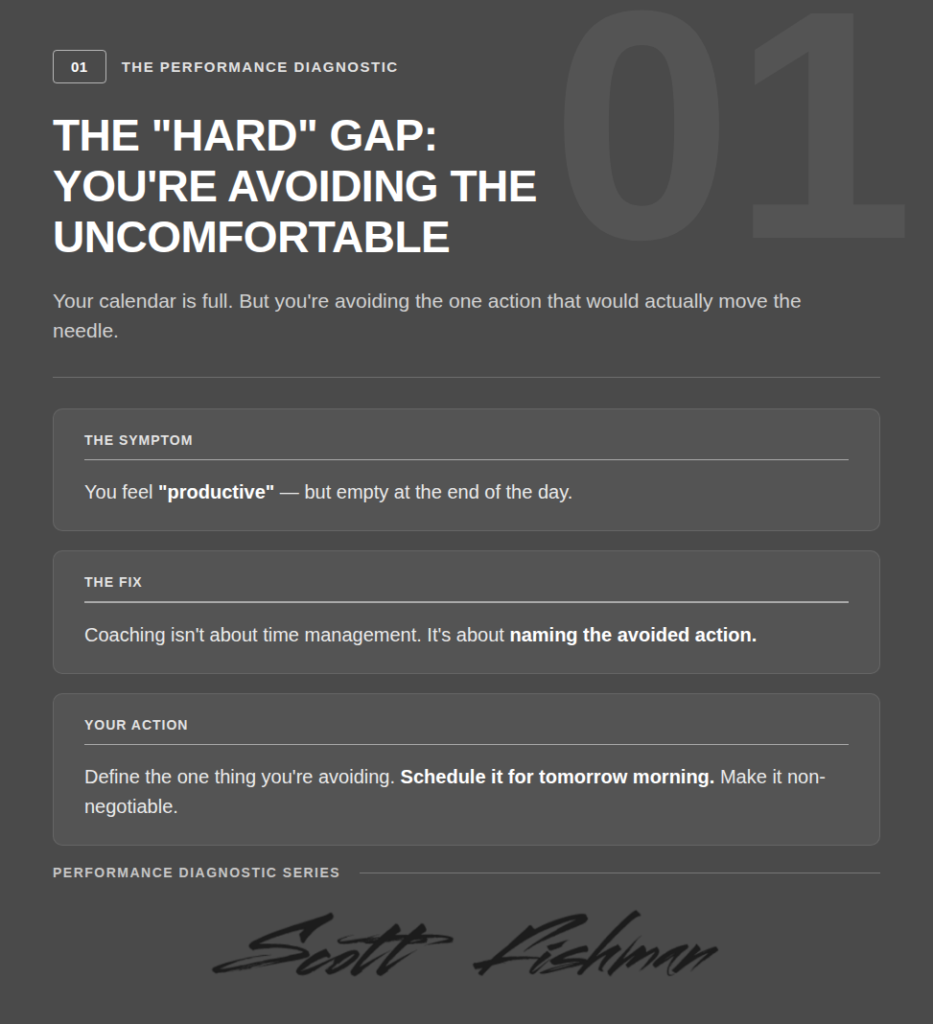
1. The “Hard” Gap: You’re Avoiding the Uncomfortable
You are busy. Your calendar is full. But you are avoiding the one action—the uncomfortable sales call, the difficult conversation with a teammate, the launch of a new offer—that would actually move the needle.
The Symptom: You feel “productive” but empty at the end of the day.
The Fix: Performance coaching isn’t about time management; it’s about naming the avoided action.
Your Action: What is the one thing you are currently avoiding that you know you need to do to hit your Q3 goal? Define it, schedule it for tomorrow morning, and make it non-negotiable.
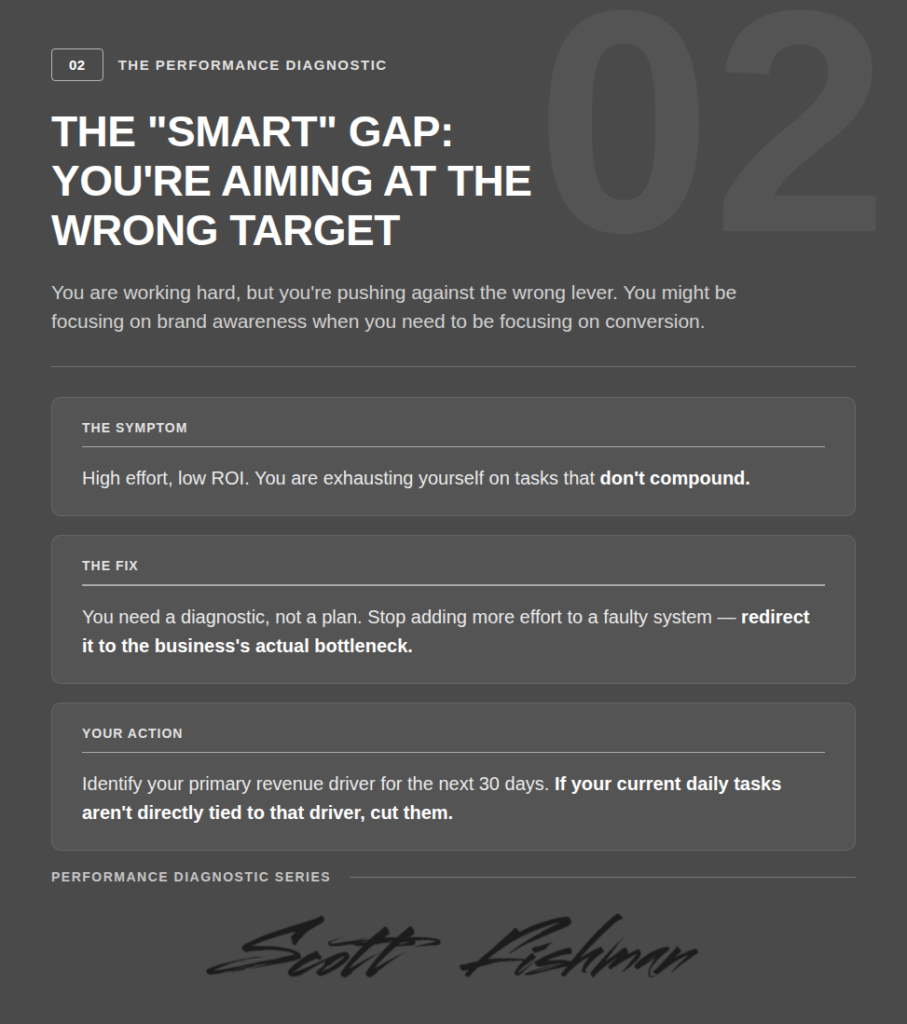
2. The “Smart” Gap: You’re Aiming at the Wrong Target
You are working hard, but you’re pushing against the wrong lever. You might be focusing on brand awareness when you need to be focusing on conversion, or hiring more staff when you need to be refining your offer.
The Symptom: High effort, low ROI. You are exhausting yourself on tasks that don’t compound.
The Fix: You need a diagnostic, not a plan. Stop adding more effort to a faulty system. Redirect your current effort to the business’s actual bottleneck.
Your Action: Identify your primary revenue driver for the next 30 days. If your current daily tasks aren’t directly tied to that driver, cut them.
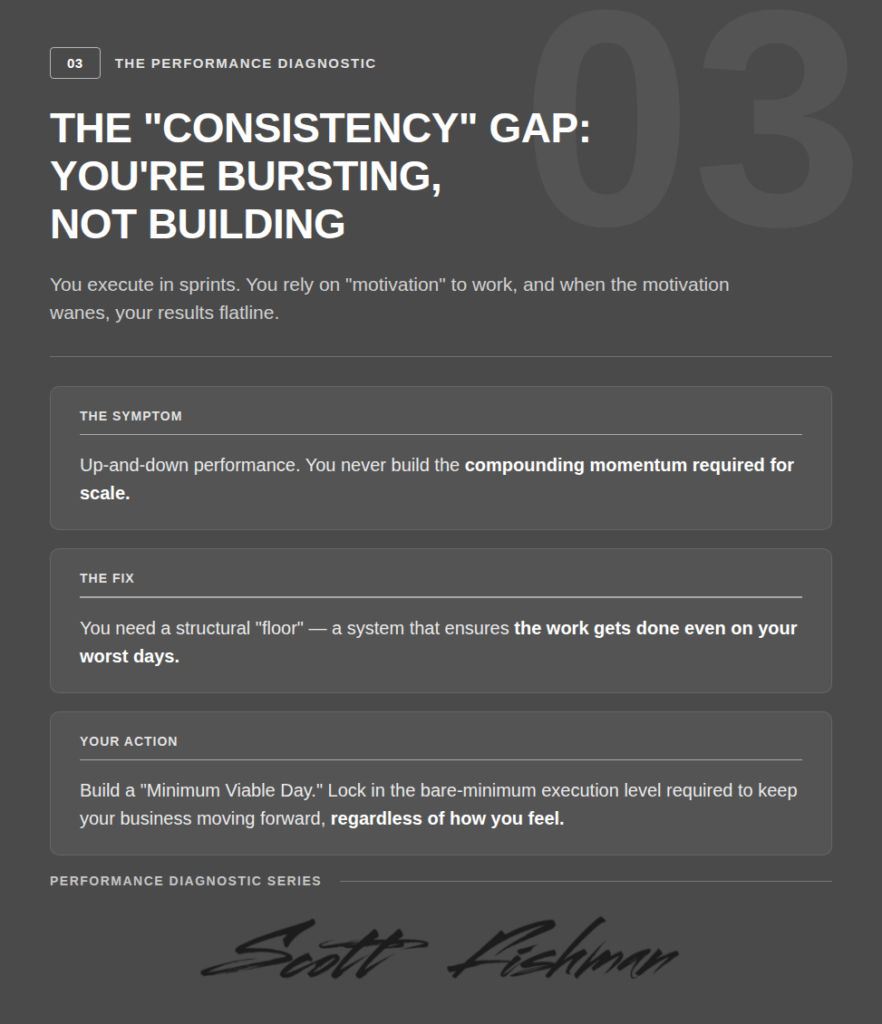
3. The “Consistency” Gap: You’re Bursting, Not Building
You execute in sprints. You have a great week followed by a stagnant one. You rely on “motivation” to work, and when the motivation wanes, your results flatline.
The Symptom: Up-and-down performance. You never build the compounding momentum required for scale.
The Fix: You need a structural “floor.” You need a system that ensures the work gets done even on your worst days.
Your Action: Build a “Minimum Viable Day.” What is the absolute, bare-minimum execution level required to keep your business moving forward? Lock that in as your floor, regardless of how you feel.
What High-Performance Leadership Actually Looks Like
A leader can usually build a strategy. What is nearly impossible to do alone is to see your own blind spots in real time.
When you’re inside the game, a “Hard” problem feels exactly like a “Smart” problem: just pure frustration.
I don’t offer generic consulting. I provide the same high-performance diagnostics I used to get athletes to the podium, applied to your business. We don’t just plan; we diagnose, we isolate the gap, and we execute until the scoreboard changes. This is the same diagnostic I bring to a room as a high-performance keynote speaker when I work with a leadership team live.
Hire Scott to Speak — Bring the EFFORT framework to your next corporate event or leadership summit.
Frequently Asked Questions
How do I know if my business problem is strategy or execution?
If you’re working long hours and still not hitting targets, it’s almost always execution, not strategy. Run the three-part diagnostic, Hard, Smart, Consistent, against your current biggest bottleneck before buying another course or hiring another consultant to refine the plan itself.
Can I run this scorecard on my own business without a coach?
Yes, as a starting point. But a Hard problem and a Smart problem both feel like pure frustration from the inside, which is why a leader can usually build a strategy alone but rarely sees their own blind spot alone. An outside diagnostic tends to isolate the real gap faster.
What’s a “Minimum Viable Day” and why does it fix a Consistency gap?
It’s the bare minimum execution level that keeps the business moving forward regardless of how you feel that day. Consistency gaps come from relying on motivation to work, and motivation is unreliable by design, so locking in a floor that holds on the worst days is what actually fixes it.
Scott H. Fishman is the author of Effort. Scott earned a Bachelor of Education from the University of Miami and later studied Sports Psychology in grad school at the United States Sports Academy. Coach Scott Fishman has earned the top training certifications including CSCS from National Strength and Conditioning Association (NSCA) as well as certification from USA Track and Field (USATF), USA Weightlifting (USAW), USA Basketball (USAB), National Council on Strength and Fitness (NCSF), and more. With 20 years of experience designing high-performance systems for professional athletes, teams and organizations, Scott Fishman is now a keynote speaker. Scott founded Team All-American, AllWorldU, and is the Chairperson of the Board at United Sports Association (U.S.A.). As an athlete, Scott played professional basketball for the Virginia Wolverines (EBA) and North Jersey Pros (EBA). He’s also a marathon runner. Scott is from New York originally and currently resides in the Greater Tampa Bay Area. Scott is the Executive Director of the St. Pete Marathon and the Director of Growth at Winsignia.
Quick answer: Most teams underperform for one of three reasons: they’re avoiding the genuinely hard work, their effort is aimed at the wrong target, or their execution only shows up in bursts instead of holding steady. This diagnostic, Hard, Smart, Consistent, pinpoints which one is actually missing before you build a new plan.
Most people respond to underperformance the same way: add more. More time, more energy, more changes. It rarely works, because the missing piece usually isn’t more hard effort. It’s more smart effort, and more consistent effort. Nobody stopped to diagnose which one was actually missing before piling on more of the wrong one.
I’ve run this diagnosis for twenty years. First with athletes at Team All-American, then with business owners through Winsignia. Every new athlete and every new business owner who comes to me for help shows the same pattern underneath, which is exactly why the fix hasn’t changed either. Here’s how to actually run it.
Ask “Why Aren’t We Winning More?” — Just Ask It the Right Way
When performance stalls, the instinct is to ask a vague question: why isn’t this working? That question doesn’t generate the best answer, because it’s too broad to point at anything specific.
The better question is: which of three things is actually missing?In my EFFORT Framework, every performance problem — an athlete’s plateau, a stalled sales quarter, a business that’s flatlined — traces back to a gap in one of its three pillars: Hard, Smart, or Consistent.
Diagnose which one, and you know exactly which one to fix. Skip the diagnosis, and you’ll fix the wrong thing, which is worse than fixing nothing. It burns time, energy, and morale on a problem that was never real.
Step One: Check for a Hard Problem
Ask honestly: is the effort here actually difficult, or does it just feel like a lot of activity?
There’s a specific tell. A Hard problem shows up as busyness without discomfort. The person or team is doing plenty of time-consuming things but avoiding the specific thing that’s uncomfortable: the direct sales ask, the technical fix that takes real focus, the training block that hurts. If the schedule is full but nothing hard is actually happening, that’s your answer.
Fix: Name the specific uncomfortable task being avoided, and make it the first thing on the list, not the thing squeezed in if there’s time left.
Step Two: Check for a Smart Problem
Ask: is the hard work actually pointed at the right target? Better yet, the bullseye.
This is the harder gap to see from the inside, because it doesn’t look like a problem. It looks like effort. A Smart problem shows up as real, sustained work that still isn’t producing results, because it’s aimed at the wrong lever. An athlete grinding out miles with no purpose behind them. A business owner working every day on a marketing channel that was never going to reach their actual customer.
Fix: Before adding more time, verify the target. Ask what specific outcome this work is supposed to produce, and whether the activity is actually connected to that outcome or just adjacent to it.
Step Three: Check for a Consistency Problem
Ask: is this happening every time, or just when it’s convenient?
This is the one people underestimate the most, because a single hard, smart week feels like proof the plan is working. But performance — physical or business — compounds off pattern, not peaks. Two strong weeks followed by two weak ones don’t average out to progress. They usually net out to less than doing nothing at a steady pace would have.
Fix: Look at the last month, not the last week. If the hard, smart work only shows up in bursts, consistency is the actual bottleneck, and no amount of strategy will fix it until the pattern does.
Why Most People Get the Diagnosis Wrong
The reason this diagnosis is hard to run on yourself is that all three gaps can look like the same symptom from the inside — stuck, frustrated, working hard and not seeing results. The instinct in that state is almost always to add more effort in whatever direction you’re already facing, which only helps if that direction happens to be the actual gap. Most of the time, it isn’t, which is why “just work harder” fixes so little.
This is also exactly what I run in a room when I speak — the diagnostic itself, live, with real examples from coaching athletes and growing Winsignia clients, so a team walks out with a way to run this on themselves afterward, not just a story about how I ran it once.
Run This on Your Team Before Your Next Push
If you’re planning a sales kickoff, a training cycle, or any kind of performance reset, running this diagnosis first — before setting new goals — changes what the goals should even be. A team missing “hard” needs a different plan than a team missing “consistent,” and most goal-setting sessions skip the diagnosis entirely and jump straight to the target.
This is the same framework behind my work as a high-performance keynote speaker — built from two decades of coaching, and the core of what I bring to a stage or a working session with a team that’s ready to actually find the gap instead of guessing at it.
Scott H. Fishman is the author of Effort. Scott earned a Bachelor of Education from the University of Miami and later studied Sports Psychology in grad school at the United States Sports Academy. Coach Scott Fishman has earned the top training certifications including CSCS from National Strength and Conditioning Association (NSCA) as well as certification from USA Track and Field (USATF), USA Weightlifting (USAW), USA Basketball (USAB), National Council on Strength and Fitness (NCSF), and more. With 20 years of experience designing high-performance systems for professional athletes, teams and organizations, Scott Fishman is now a keynote speaker. Scott founded Team All-American, AllWorldU, and is the Chairperson of the Board at United Sports Association (U.S.A.). As an athlete, Scott played professional basketball for the Virginia Wolverines (EBA) and North Jersey Pros (EBA). He’s also a marathon runner. Scott is from New York originally and currently resides in the Greater Tampa Bay Area. Scott is the Executive Director of the St. Pete Marathon and the Director of Growth at Winsignia.