• How to Run the EFFORT Diagnostic on Yourself

    How to Run the EFFORT Diagnostic on Yourself

    Most performance advice jumps straight to a plan. A new strategy, a new training block, a new productivity system, without first diagnosing what’s actually missing. That’s backwards, and it’s the single biggest reason good plans fail to produce results.

    I built the EFFORT Framework, Hard, Smart, Consistent, to fix that, and you can read the full framework here. What most people never get is a way to actually run it on themselves. Here’s how.

    Why the Diagnosis Has to Come First

    A leader working sixty hour weeks doesn’t need more hours. If the real issue is a Smart gap, more hours aimed at the wrong target just produces more exhaustion, not more revenue. A leader with a great strategy and inconsistent execution doesn’t need a better strategy. They need a floor that holds on the bad weeks. The fix only works when it’s aimed at the actual gap, which is why the diagnosis has to happen before any plan gets built, every time.

    The Three Questions

    Ask these honestly, about whatever’s currently stalled.

    Is the effort here actually difficult, or does it just feel like a lot of activity? If the schedule is full but nothing genuinely uncomfortable is happening, that’s a Hard gap.

    Is the hard work pointed at the right target? If real, sustained effort still isn’t producing results, check whether it’s aimed at what actually matters or just at what’s familiar. That’s a Smart gap.

    Is this happening every time, or only when it’s convenient? Look at the last month, not the last week. If the pattern only shows up in bursts, that’s a Consistency gap, and no amount of strategy fixes it until the pattern does.

    Why This Is Hard to Run on Yourself

    All three gaps feel identical from the inside, the same frustration of working hard and not seeing enough return. That’s exactly why an outside diagnostic, a coach, a framework, a second set of eyes, catches what self assessment alone tends to miss. Running the three questions honestly is a start. Having someone else run them with you is usually what actually surfaces the real answer.

    This is the same diagnostic I run with teams from the stage as a high-performance keynote speaker — Hard, Smart, Consistent, live, with a room instead of just a page.

    Book Scott to speak →

    Scott H. Fishman is the author of Effort. Scott earned a Bachelor of Education from the University of Miami and later studied Sports Psychology in grad school at the United States Sports Academy. Coach Scott Fishman has earned the top training certifications including CSCS from National Strength and Conditioning Association (NSCA) as well as certification from USA Track and Field (USATF), USA Weightlifting (USAW), USA Basketball (USAB), National Council on Strength and Fitness (NCSF), and more. With 20 years of experience designing high-performance systems for professional athletes, teams and organizations, Scott Fishman is now a keynote speaker. Scott founded Team All-American, AllWorldU, and is the Chairperson of the Board at United Sports Association (U.S.A.). As an athlete, Scott played professional basketball for the Virginia Wolverines (EBA) and North Jersey Pros (EBA). He’s also a marathon runner. Scott is from New York originally and currently resides in the Greater Tampa Bay Area. Scott is the Executive Director of the St. Pete Marathon and the Director of Growth at Winsignia.

    Related Reading

    The CEO’s Business Performance Diagnostic

    Why Your Team is Not Performing Well
    High-Performance Keynote Speaker: Scott Fishman

  • How to Improve Team Cohesion

    How to Improve Team Cohesion

    Culture and cohesion get used interchangeably, and that’s a mistake that costs teams more than people realize. Culture is the standard a team holds. Cohesion is whether the people actually trust each other enough to hold it together under pressure. You can have a strong stated culture and still watch it fall apart in a crunch because the team never built real cohesion underneath it.

    I’ve watched this exact gap show up on rosters and in businesses for twenty years. Here’s what actually builds cohesion, not just the appearance of it.

    Cohesion Is Built Under Pressure, Not at Offsites

    The instinct is to build cohesion through comfort, team dinners, trust falls, an offsite with good catering. Those aren’t harmful, but they don’t build what you think they build. Real cohesion gets tested and formed under pressure, not around a table when everything’s easy.

    The athletes on the teams I coached that trusted each other most weren’t the ones who hung out most off the field. They were the ones who’d been through a hard fourth quarter together and watched each other actually deliver. Trust built under pressure is durable. Trust built over dinner is pleasant, but it hasn’t been tested yet.

    Action step: look for the next genuinely hard moment on your team’s calendar, a tight deadline, a difficult client, a launch under pressure, and treat it as a cohesion building opportunity, not just a stressful week to survive.

    Cohesion Requires Knowing What Teammates Actually Do

    A surprising amount of low cohesion traces back to something simple. People don’t actually understand what their teammates are responsible for or what pressure they’re under. Without that, it’s easy to assume a slow response is laziness instead of someone buried in something you can’t see.

    On a team, this shows up as a guard who doesn’t understand why the center is gassed by the fourth quarter. In a business, it shows up as sales assuming marketing isn’t pulling their weight, without knowing marketing is three deep in an approval bottleneck they don’t control. Cohesion starts closing the moment people can see what’s actually on someone else’s plate.

    Action step: build a habit of surfacing what each person is actually dealing with, not just what they delivered. A five minute round where people name their current bottleneck does more for cohesion than most team building exercises.

    Cohesion Breaks Down Without Shared Accountability

    Nothing erodes cohesion faster than a team watching one person coast without consequence. It doesn’t matter how strong the relationships are otherwise. Once a team sees the standard doesn’t apply evenly, trust in the group starts to crack, quietly, and usually before a leader notices.

    This connects directly to the Consistent pillar in my EFFORT Framework. A team’s cohesion isn’t just about how people treat each other. It’s about whether the standard holds the same for everyone, every time. I’ve written elsewhere about how that framework plays out across sport and business, but the cohesion specific version of it is this: uneven accountability is the fastest way to turn a group of talented individuals into a team that doesn’t trust each other.

    Cohesion Needs a Shared Way to Name the Problem

    Teams with real cohesion have language for naming what’s going wrong without it turning into a personal attack. Without that shared language, a real issue either goes unsaid, or it comes out sideways as frustration directed at a person instead of the actual gap.

    This is part of why I build shared vocabulary into the teams I work with, whether that’s an athletic roster or a sales floor. A team that can say “that’s a Hard problem, not a Smart problem” is naming a gap, not a person, which keeps the conversation about the work instead of about blame.

    Cohesion Is a Byproduct, Not a Goal

    The teams with the strongest cohesion I’ve coached weren’t chasing cohesion directly. They were chasing a shared standard, held consistently, with real visibility into what everyone else was carrying. Cohesion showed up as the result of that, not as something built on its own.

    If you’re trying to improve cohesion on your team, the fastest path usually isn’t a cohesion exercise. It’s tightening the standard, making sure it holds evenly, and giving people a way to actually see what their teammates are up against.

    This is the same work I bring into a room as a high-performance keynote speaker, walking teams through where their real gap is so cohesion becomes a byproduct of a shared standard, not a separate initiative competing for time on the calendar.

    Book Scott to speak →

    This post is part of a series exploring the Hard-Smart-Consistent framework across sport, business, and life. Read more in Effort, or explore how the framework built Team All-American, United Sports Association, and more.

    Related Reading

    Building a Championship Culture at Work

    Why Your Team Is Not Performing Well

    Scott H. Fishman is the author of Effort. Scott earned a Bachelor of Education from the University of Miami and later studied Sports Psychology in grad school at the United States Sports Academy. Coach Scott Fishman has earned the top training certifications including CSCS from National Strength and Conditioning Association (NSCA) as well as certification from USA Track and Field (USATF), USA Weightlifting (USAW), USA Basketball (USAB), National Council on Strength and Fitness (NCSF), and more. With 20 years of experience designing high-performance systems for professional athletes, teams and organizations, Scott Fishman is now a keynote speaker. Scott founded Team All-American, AllWorldU, and is the Chairperson of the Board at United Sports Association (U.S.A.). As an athlete, Scott played professional basketball for the Virginia Wolverines (EBA) and North Jersey Pros (EBA). He’s also a marathon runner. Scott is from New York originally and currently resides in the Greater Tampa Bay Area. Scott is the Executive Director of the St. Pete Marathon and the Director of Growth at Winsignia.

  • Habits of Elite Athletes vs Executives

    Habits of Elite Athletes vs Executives

    I’ve coached both. Twenty years with elite athletes at Team All-American, followed by the same diagnostic work with executives through Winsignia. What surprised me early on wasn’t how different those two worlds are. It’s how identical the habits of the ones who actually perform turn out to be, once you strip away the uniform.

    Here’s the real comparison, not the surface level one about early mornings and cold showers.

    Elite Athletes Train the Specific Weakness. Executives Avoid It.

    An athlete who’s slow off the line doesn’t spend more time on the drills they’re already good at. A good coach puts them directly into the uncomfortable rep, over and over, until the weakness closes. There’s no ego protection in that room. The weakness gets named and worked, publicly, immediately.

    Executives do the opposite by habit, not by character flaw. They spend more time in the parts of the job they’re already strong in, because that’s where the wins feel good and fast. The specific, uncomfortable gap, the hard sales conversation, the underperforming hire, the number that doesn’t add up, gets circled around instead of trained directly. This is the Hard gap in the EFFORT framework, and it’s the single biggest habit difference between the two worlds.

    Elite Athletes Measure the Right Number. Executives Measure the Comfortable One.

    Athletes at the top level track a small number of metrics that actually predict performance, not the ones that feel good to watch improve. A sprinter isn’t obsessing over total miles run in a week. They’re tracking split times on the specific phase of the race that’s costing them.

    Executives, by contrast, often default to tracking activity, hours worked, meetings held, emails sent, because activity is easy to measure and easy to feel proud of. That’s the Smart gap. The habit that separates a performing executive from a busy one is choosing to track the one number tied directly to the actual outcome, even when it’s an uncomfortable number to look at daily.

    Elite Athletes Have a Floor. Executives Have a Ceiling.

    This is the habit gap that surprises people most. Elite athletes are famous for their peak performances, the record, the highlight, the podium finish. But what actually built that peak is a floor, a minimum standard of training that holds on the days they don’t feel like it, are sore, are dealing with something outside of sport entirely.

    Executives tend to build the opposite structure. They have an impressive ceiling, the big presentation, the great quarter, the strong pitch, but no real floor underneath it. When motivation dips, execution drops with it, because there was never a non-negotiable minimum in place to catch the bad week. This is the Consistent pillar, and it’s the habit that compounds the most over a career, for better or worse.

    Elite Athletes Get Diagnosed by Someone Else. Executives Diagnose Themselves, Badly.

    Every serious athlete has a coach watching from outside, someone whose entire job is to see the gap the athlete can’t see from inside their own effort. That’s not a luxury. It’s a structural habit built into how elite performance actually develops.

    Most executives never build that in. They’re the smartest, most self aware person in most rooms they’re in, which paradoxically makes it harder to admit they can’t diagnose their own blind spot the same way an outside eye can. The habit that separates the executives who keep growing from the ones who plateau isn’t intelligence. It’s whether they’ve built in someone whose job is to see what they can’t.

    What This Means for How You Build Your Own Habits

    The good news buried in this comparison is that none of these habits require an athletic background to build. They require the same honest diagnosis, whether the gap is Hard, Smart, or Consistent, and the discipline to build a floor instead of chasing another ceiling. That diagnostic is the same one I run with every Winsignia client and the same one I bring into a room as a high-performance keynote speaker.

    Book Scott to speak →

    Related Reading

    Focus Strategies for Peak Performance

    Building High Performance Habits That Actually Stick

    Scott H. Fishman is the author of Effort. Scott earned a Bachelor of Education from the University of Miami and later studied Sports Psychology in grad school at the United States Sports Academy. Coach Scott Fishman has earned the top training certifications including CSCS from National Strength and Conditioning Association (NSCA) as well as certification from USA Track and Field (USATF), USA Weightlifting (USAW), USA Basketball (USAB), National Council on Strength and Fitness (NCSF), and more. With 20 years of experience designing high-performance systems for professional athletes, teams and organizations, Scott Fishman is now a keynote speaker. Scott founded Team All-American, AllWorldU, and is the Chairperson of the Board at United Sports Association (U.S.A.). As an athlete, Scott played professional basketball for the Virginia Wolverines (EBA) and North Jersey Pros (EBA). He’s also a marathon runner. Scott is from New York originally and currently resides in the Greater Tampa Bay Area. Scott is the Executive Director of the St. Pete Marathon and the Director of Growth at Winsignia.

  • Building a Championship Culture at Work

    Building a Championship Culture at Work

    Every championship team I’ve ever coached or played on had one thing in common that had nothing to do with talent. The best team doesn’t always win. The team with the strongest culture usually does.

    Business leaders talk about culture constantly, then default to free lunches and a mission statement on the wall. That’s not culture. Culture is what a team does when nobody’s watching and nothing’s on the line. It’s the standard that holds on a Tuesday afternoon in March, not just during the playoff push.

    I spent two decades building that standard with athletes at Team All-American before I started building it inside businesses through Winsignia. The mechanics are identical. Here’s what actually builds it.

    Culture Is a Standard, Not a Value

    Most companies write down values. Few build standards. A value is something you believe. A standard is something you enforce, every time, regardless of mood, workload, or who’s involved.

    If your team’s standard is “we respond to clients within 24 hours,” that only becomes culture once it holds during a bad week, not just a good one. The teams I coached that won consistently weren’t the ones with the best pep talks. They were the ones where the standard didn’t move when the pressure did.

    Action step: pick one behavior your team already claims to value and check whether it actually holds under pressure. If it doesn’t, you don’t have a value problem. You have an enforcement problem.

    Championship Teams Are Built on Consistency, Not Motivation

    This ties directly into the Consistent pillar of the EFFORT framework I coach leaders through: motivation is unreliable by design. It spikes around a big game, a launch, a new hire, then fades. A championship culture doesn’t depend on everyone feeling inspired. It depends on a floor of execution that holds even when motivation is gone.

    The athletes who made it weren’t the ones who trained hardest on their best days. They were the ones whose worst day still looked like a real training session. The same is true inside a company. A team with real culture still hits its numbers in a slow quarter, still shows up prepared for a client call nobody’s excited about.

    Leaders Set the Ceiling, Not the Floor

    Here’s what most leaders get backwards. They think culture is what they inspire on their best day, the keynote, the all hands meeting, the big vision speech. Culture is actually set by what a leader tolerates on their worst day.

    If a leader lets one person coast, miss deadlines, or treat teammates poorly without consequence, that tolerance becomes the real standard, no matter what’s written in the values doc. Athletes figure this out about a coach in about a week. Employees figure it out about a leader just as fast.

    Action step: look at the last time someone underperformed on your team and ask what actually happened. Whatever happened, or didn’t, is your real culture.

    Championship Culture Needs a Shared Language

    One thing that separates teams that talk about culture from teams that live it is language. Championship teams have shorthand, specific phrases everyone understands that point directly at the standard. “That’s a hard problem, not a smart problem” means something instantly to an athlete I’ve coached. It should mean something instantly to your team too.

    Without shared language, culture stays abstract. With it, a manager can name a lapse in five words instead of a ten minute conversation, and the team can course correct in real time instead of after the damage is done.

    Build the Diagnostic Into the Culture, Not Just the Leader’s Head

    A lot of leaders can diagnose a performance gap when they see one. Fewer build that diagnostic into how the whole team operates. A real championship culture means your team can self correct without you in the room, because they’ve internalized the same standard you’d apply.

    This is the same diagnostic I run with teams from the stage as a high-performance keynote speaker, walking a room through Hard, Smart, and Consistent so they leave with a shared way to catch their own gaps, not just a story about a team that once had one.

    Culture Compounds. That’s the Whole Point.

    The reason culture matters more than any single strategy is that it compounds. A great strategy executed once produces one good result. A real standard, enforced consistently, produces a program that wins for years, on the field or in a business. That’s the entire argument for building it deliberately instead of hoping it shows up on its own.

    Book Scott to speak →

    Related Reading

    How to Improve Team Cohesion

    Why Your Team Is Not Performing Well

    Scott H. Fishman is the author of Effort. Scott earned a Bachelor of Education from the University of Miami and later studied Sports Psychology in grad school at the United States Sports Academy. Coach Scott Fishman has earned the top training certifications including CSCS from National Strength and Conditioning Association (NSCA) as well as certification from USA Track and Field (USATF), USA Weightlifting (USAW), USA Basketball (USAB), National Council on Strength and Fitness (NCSF), and more. With 20 years of experience designing high-performance systems for professional athletes, teams and organizations, Scott Fishman is now a keynote speaker. Scott founded Team All-American, AllWorldU, and is the Chairperson of the Board at United Sports Association (U.S.A.). As an athlete, Scott played professional basketball for the Virginia Wolverines (EBA) and North Jersey Pros (EBA). He’s also a marathon runner. Scott is from New York originally and currently resides in the Greater Tampa Bay Area. Scott is the Executive Director of the St. Pete Marathon and the Director of Growth at Winsignia.

  • The CEO’s Business Performance Diagnostic Scorecard

    The CEO’s Business Performance Diagnostic Scorecard

    Most business leaders think they have a strategy problem. They buy the courses, hire the consultants, and refine their funnels—yet, the needle refuses to move.

    After twenty years of coaching elite athletes and business leaders, I’ve learned the truth: Strategy is rarely the bottleneck. Execution is.

    If you are working 60-hour weeks but aren’t hitting your targets, you don’t need a new strategy. You have a Performance Gap.

    In my coaching practice at Winsignia, I use a simple, three-part diagnostic to identify exactly where a leader is breaking down. I call it the EFFORT Framework. This is the diagnostic at the center of my performance consulting work with business leaders.

    You can use my scorecard to diagnose your own performance today.

    The Performance Diagnostic: Where Are You Failing?

    Look at your current biggest business challenge and identify which of these three buckets it falls into.

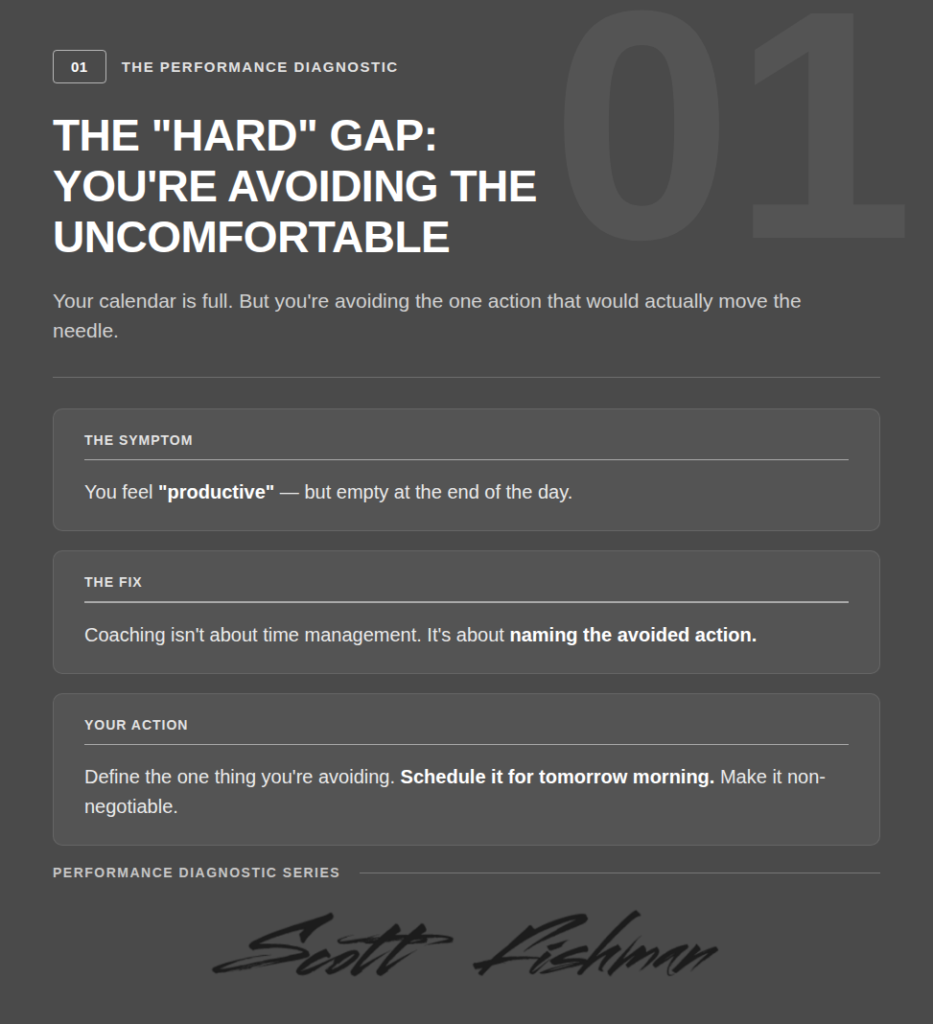
    1. The “Hard” Gap: You’re Avoiding the Uncomfortable

    You are busy. Your calendar is full. But you are avoiding the one action—the uncomfortable sales call, the difficult conversation with a teammate, the launch of a new offer—that would actually move the needle.

    • The Symptom: You feel “productive” but empty at the end of the day.
    • The Fix: Performance coaching isn’t about time management; it’s about naming the avoided action.
    • Your Action: What is the one thing you are currently avoiding that you know you need to do to hit your Q3 goal? Define it, schedule it for tomorrow morning, and make it non-negotiable.

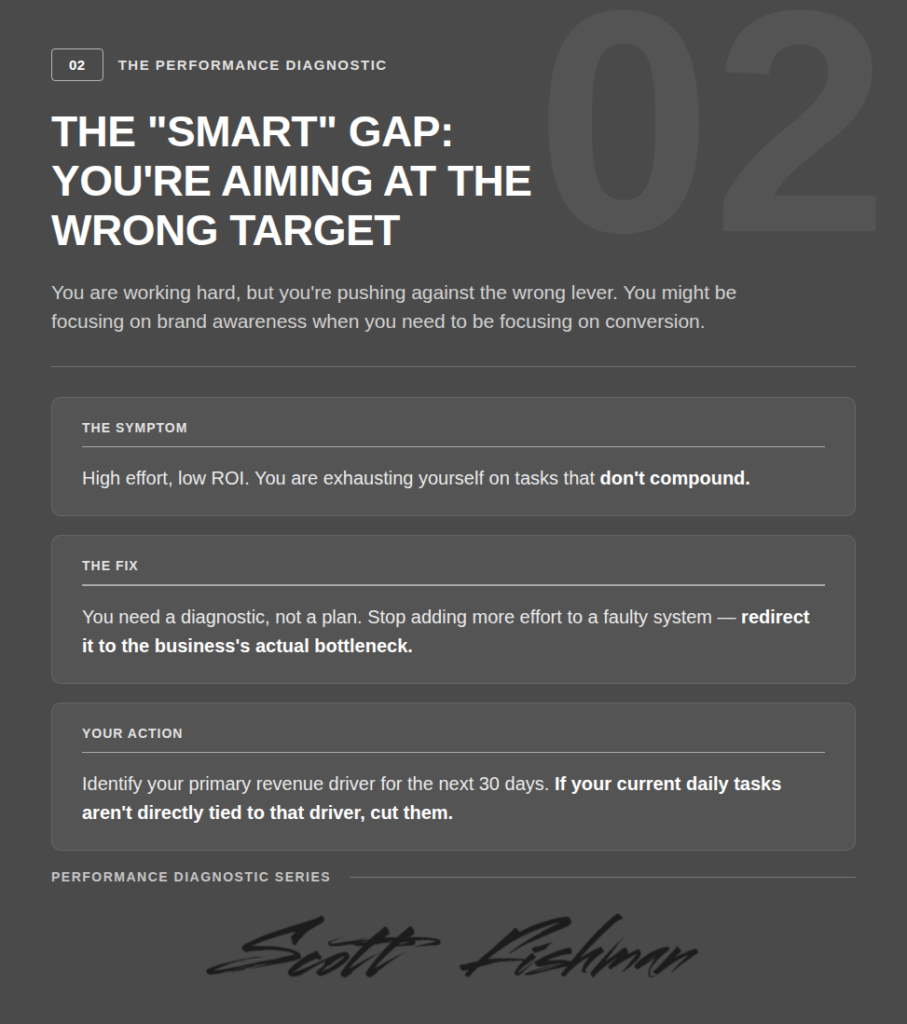
    2. The “Smart” Gap: You’re Aiming at the Wrong Target

    You are working hard, but you’re pushing against the wrong lever. You might be focusing on brand awareness when you need to be focusing on conversion, or hiring more staff when you need to be refining your offer.

    • The Symptom: High effort, low ROI. You are exhausting yourself on tasks that don’t compound.
    • The Fix: You need a diagnostic, not a plan. Stop adding more effort to a faulty system. Redirect your current effort to the business’s actual bottleneck.
    • Your Action: Identify your primary revenue driver for the next 30 days. If your current daily tasks aren’t directly tied to that driver, cut them.

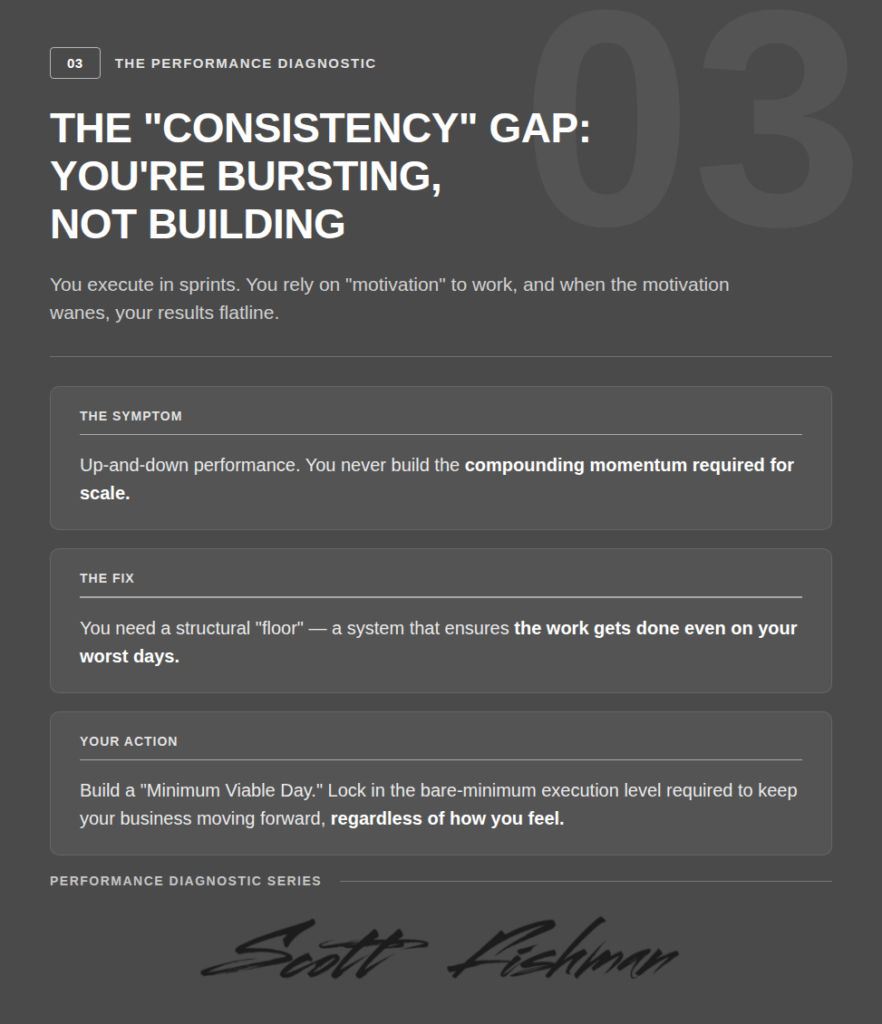
    3. The “Consistency” Gap: You’re Bursting, Not Building

    You execute in sprints. You have a great week followed by a stagnant one. You rely on “motivation” to work, and when the motivation wanes, your results flatline.

    • The Symptom: Up-and-down performance. You never build the compounding momentum required for scale.
    • The Fix: You need a structural “floor.” You need a system that ensures the work gets done even on your worst days.
    • Your Action: Build a “Minimum Viable Day.” What is the absolute, bare-minimum execution level required to keep your business moving forward? Lock that in as your floor, regardless of how you feel.

    Stop Guessing. Start Performing.

    A leader can usually build a strategy. What is nearly impossible to do alone is to see your own blind spots in real time.

    When you’re inside the game, a “Hard” problem feels exactly like a “Smart” problem: just pure frustration.

    I don’t offer generic consulting. I provide the same high-performance diagnostics I used to get athletes to the podium, applied to your business. We don’t just plan; we diagnose, we isolate the gap, and we execute until the scoreboard changes. This is the same diagnostic I bring to a room as a high-performance keynote speaker when I work with a leadership team live.

    Ready to audit your performance?

    Related Reading

    Why Your Team Is Not Performing Well

    Sports Psychology for Athletes (and CEOs)

    Scott H. Fishman is the author of Effort. Scott earned a Bachelor of Education from the University of Miami and later studied Sports Psychology in grad school at the United States Sports Academy. Coach Scott Fishman has earned the top training certifications including CSCS from National Strength and Conditioning Association (NSCA) as well as certification from USA Track and Field (USATF), USA Weightlifting (USAW), USA Basketball (USAB), National Council on Strength and Fitness (NCSF), and more. With 20 years of experience designing high-performance systems for professional athletes, teams and organizations, Scott Fishman is now a keynote speaker. Scott founded Team All-American, AllWorldU, and is the Chairperson of the Board at United Sports Association (U.S.A.). As an athlete, Scott played professional basketball for the Virginia Wolverines (EBA) and North Jersey Pros (EBA). He’s also a marathon runner. Scott is from New York originally and currently resides in the Greater Tampa Bay Area. Scott is the Executive Director of the St. Pete Marathon and the Director of Growth at Winsignia.

  • Sports Psychology for Athletes (and CEOs)

    Sports Psychology for Athletes (and CEOs)

    Sports psychology gets treated like a niche field for competitive athletes. Visualization, mental toughness, performance anxiety, all filed under “things elite runners and Olympians deal with.” I’ve spent twenty years coaching athletes and, more recently, business owners, and I can tell you plainly: the CEOs I work with have the exact same mental patterns as the athletes. Just dressed in a suit instead of a singlet.

    The Mental Game Doesn’t Know the Difference Between a Track and a Boardroom

    An athlete standing at the start line of a race they’re not sure they can finish is running the same internal script as a founder walking into a pitch meeting they’re not sure they can win. The physiology is different. The psychology is nearly identical: fear of a specific, visible failure, in front of people, with no way to hide the result.

    I’ve watched the same three mental failure points show up in both groups, over and over, regardless of whether the person’s next challenge is a marathon or a board meeting.

    Failure Point One: Confusing Nerves With a Signal to Stop

    Athletes feel pre-race nerves and interpret them as evidence they’re not ready. Business owners feel the same nerves before a big ask, a hard conversation, or a launch, and interpret them the same way: as a sign to hesitate or pull back.

    In both cases, the nerves are just information that the moment matters, not information that you’re unprepared. The athletes and business leaders who perform best haven’t eliminated the nerves. They’ve stopped treating the nerves as a verdict.

    Failure Point Two: Managing Effort Around Fear Instead of Around the Actual Goal

    This is where sports psychology and business performance overlap most directly. An athlete who’s afraid of failing a workout will often unconsciously make it easier, without realizing that’s what they’re doing. A business owner who’s afraid a client will say no will avoid the direct ask and settle for a softer, safer version of the pitch that’s easier to hear rejected.

    Both are the same behavior: letting fear quietly edit the plan down to something less likely to hurt if it fails, and also less likely to actually work.

    Failure Point Three: No Recovery Plan for the Bad Day

    Elite athletes train for the mental reality that some days will be bad. It’s built into the plan; a rough workout doesn’t derail the season, because the athlete expected some rough workouts and knows how to reset. Most business owners don’t build that same expectation in. A bad week, a lost deal, a launch that flops, hits them like proof the whole plan was wrong, instead of a data point any performer should have expected.

    The athletes and CEOs who last are the ones who’ve mentally priced in the bad day in advance, so it doesn’t cost them the whole plan when it shows up.

    What This Means If You Coach Either One

    If you’re coaching athletes, business leaders, or both, the mental game isn’t actually two different disciplines. It’s the same psychology, wearing different clothes. The frameworks that help an athlete manage pre-race nerves are the same frameworks that help a founder manage the fear before a hard sales call. I use the same EFFORT Framework diagnostic with both groups — Hard, Smart, Consistent — because the mental blocks that keep someone from hitting any of the three pillars are the same blocks, regardless of the scoreboard.

    This is exactly what I bring to the stage as a high-performance keynote speaker — the same psychology I’ve coached into athletes for twenty years, applied directly to teams and leaders who are running the identical mental game under a different name.

    Book Scott to speak →


    Related Reading

    The CEO’s Business Performance Diagnostic

    Building High Performance Habits That Actually Stick

    Scott H. Fishman is the author of Effort. Scott earned a Bachelor of Education from the University of Miami and later studied Sports Psychology in grad school at the United States Sports Academy. Coach Scott Fishman has earned the top training certifications including CSCS from National Strength and Conditioning Association (NSCA) as well as certification from USA Track and Field (USATF), USA Weightlifting (USAW), USA Basketball (USAB), National Council on Strength and Fitness (NCSF), and more. With 20 years of experience designing high-performance systems for professional athletes, teams and organizations, Scott Fishman is now a keynote speaker. Scott founded Team All-American, AllWorldU, and is the Chairperson of the Board at United Sports Association (U.S.A.). As an athlete, Scott played professional basketball for the Virginia Wolverines (EBA) and North Jersey Pros (EBA). He’s also a marathon runner. Scott is from New York originally and currently resides in the Greater Tampa Bay Area. Scott is the Executive Director of the St. Pete Marathon and the Director of Growth at Winsignia.

  • Why Your Team Is Not Performing Well

    Why Your Team Is Not Performing Well

    Most people respond to underperformance the same way: add more. More time, more energy, more changes. It rarely works, because the missing piece usually isn’t more hard effort. It’s more smart effort, and more consistent effort. Nobody stopped to diagnose which one was actually missing before piling on more of the wrong one.

    I’ve run this diagnosis for twenty years. First with athletes at Team All-American, then with business owners through Winsignia. Every new athlete and every new business owner who comes to me for help shows the same pattern underneath, which is exactly why the fix hasn’t changed either. Here’s how to actually run it.

    Ask “Why Aren’t We Winning More?” — Just Ask It the Right Way

    When performance stalls, the instinct is to ask a vague question: why isn’t this working? That question doesn’t generate the best answer, because it’s too broad to point at anything specific.

    The better question is: which of three things is actually missing?In my EFFORT Framework, every performance problem — an athlete’s plateau, a stalled sales quarter, a business that’s flatlined — traces back to a gap in one of its three pillars: Hard, Smart, or Consistent.

    Diagnose which one, and you know exactly which one to fix. Skip the diagnosis, and you’ll fix the wrong thing, which is worse than fixing nothing. It burns time, energy, and morale on a problem that was never real.

    Step One: Check for a Hard Problem

    Ask honestly: is the effort here actually difficult, or does it just feel like a lot of activity?

    There’s a specific tell. A Hard problem shows up as busyness without discomfort. The person or team is doing plenty of time-consuming things but avoiding the specific thing that’s uncomfortable: the direct sales ask, the technical fix that takes real focus, the training block that hurts. If the schedule is full but nothing hard is actually happening, that’s your answer.

    Fix: Name the specific uncomfortable task being avoided, and make it the first thing on the list, not the thing squeezed in if there’s time left.

    Step Two: Check for a Smart Problem

    Ask: is the hard work actually pointed at the right target? Better yet, the bullseye.

    This is the harder gap to see from the inside, because it doesn’t look like a problem. It looks like effort. A Smart problem shows up as real, sustained work that still isn’t producing results, because it’s aimed at the wrong lever. An athlete grinding out miles with no purpose behind them. A business owner working every day on a marketing channel that was never going to reach their actual customer.

    Fix: Before adding more time, verify the target. Ask what specific outcome this work is supposed to produce, and whether the activity is actually connected to that outcome or just adjacent to it.

    Step Three: Check for a Consistency Problem

    Ask: is this happening every time, or just when it’s convenient?

    This is the one people underestimate the most, because a single hard, smart week feels like proof the plan is working. But performance — physical or business — compounds off pattern, not peaks. Two strong weeks followed by two weak ones don’t average out to progress. They usually net out to less than doing nothing at a steady pace would have.

    Fix: Look at the last month, not the last week. If the hard, smart work only shows up in bursts, consistency is the actual bottleneck, and no amount of strategy will fix it until the pattern does.

    Why Most People Get the Diagnosis Wrong

    The reason this diagnosis is hard to run on yourself is that all three gaps can look like the same symptom from the inside — stuck, frustrated, working hard and not seeing results. The instinct in that state is almost always to add more effort in whatever direction you’re already facing, which only helps if that direction happens to be the actual gap. Most of the time, it isn’t, which is why “just work harder” fixes so little.

    This is also exactly what I run in a room when I speak — the diagnostic itself, live, with real examples from coaching athletes and growing Winsignia clients, so a team walks out with a way to run this on themselves afterward, not just a story about how I ran it once.

    Run This on Your Team Before Your Next Push

    If you’re planning a sales kickoff, a training cycle, or any kind of performance reset, running this diagnosis first — before setting new goals — changes what the goals should even be. A team missing “hard” needs a different plan than a team missing “consistent,” and most goal-setting sessions skip the diagnosis entirely and jump straight to the target.

    This is the same framework behind my work as a high-performance keynote speaker — built from two decades of coaching, and the core of what I bring to a stage or a working session with a team that’s ready to actually find the gap instead of guessing at it.

    Book Scott to speak →

    Scott H. Fishman is the author of Effort. Scott earned a Bachelor of Education from the University of Miami and later studied Sports Psychology in grad school at the United States Sports Academy. Coach Scott Fishman has earned the top training certifications including CSCS from National Strength and Conditioning Association (NSCA) as well as certification from USA Track and Field (USATF), USA Weightlifting (USAW), USA Basketball (USAB), National Council on Strength and Fitness (NCSF), and more. With 20 years of experience designing high-performance systems for professional athletes, teams and organizations, Scott Fishman is now a keynote speaker. Scott founded Team All-American, AllWorldU, and is the Chairperson of the Board at United Sports Association (U.S.A.). As an athlete, Scott played professional basketball for the Virginia Wolverines (EBA) and North Jersey Pros (EBA). He’s also a marathon runner. Scott is from New York originally and currently resides in the Greater Tampa Bay Area. Scott is the Executive Director of the St. Pete Marathon and the Director of Growth at Winsignia.