Quick answer: To run the EFFORT diagnostic on yourself, ask three questions: is the work actually hard or just busy, is it aimed at the right target, and is it happening every time or only when convenient. Whichever answer reveals a gap, Hard, Smart, or Consistent, is the one thing to fix first, before building any new plan.
- Key Takeaways
- The self diagnostic is three honest questions, not a personality test: is it hard, is it aimed right, is it consistent.
- The diagnosis always has to come before the plan, since the same fix rarely works for a Hard gap and a Consistency gap.
- All three gaps feel identical from the inside, which is why an outside diagnostic, a coach, or a framework usually surfaces the real answer faster than self assessment alone.
Most performance advice jumps straight to a plan. A new strategy, a new training block, a new productivity system, without first diagnosing what’s actually missing. That’s backwards, and it’s the single biggest reason good plans fail to produce results.
I built the EFFORT Framework, Hard, Smart, Consistent, to fix that, and you can read the full EFFORT Framework. What most people never get is a way to actually run it on themselves. Here’s how.
Before any of the three questions, there’s a more basic problem. On the first phone call, 93% of the athletes and business owners I talk to can’t clearly articulate their number one goal. For people specifically trying to lose weight, that number is 98%. That’s not a diagnostic gap, it’s a starting line problem, and it’s a bigger one than most people realize. You can’t run Hard, Smart, or Consistent against a goal you haven’t actually named yet.
Why the Diagnosis Has to Come First
A leader working sixty hour weeks doesn’t need more hours. If the real issue is a Smart gap, more hours aimed at the wrong target just produces more exhaustion, not more revenue. A leader with a great strategy and inconsistent execution doesn’t need a better strategy. They need a floor that holds on the bad weeks. The fix only works when it’s aimed at the actual gap, which is why the diagnosis has to happen before any plan gets built, every time.
The EFFORT Audit: Three Questions
Ask these honestly, about whatever’s currently stalled.
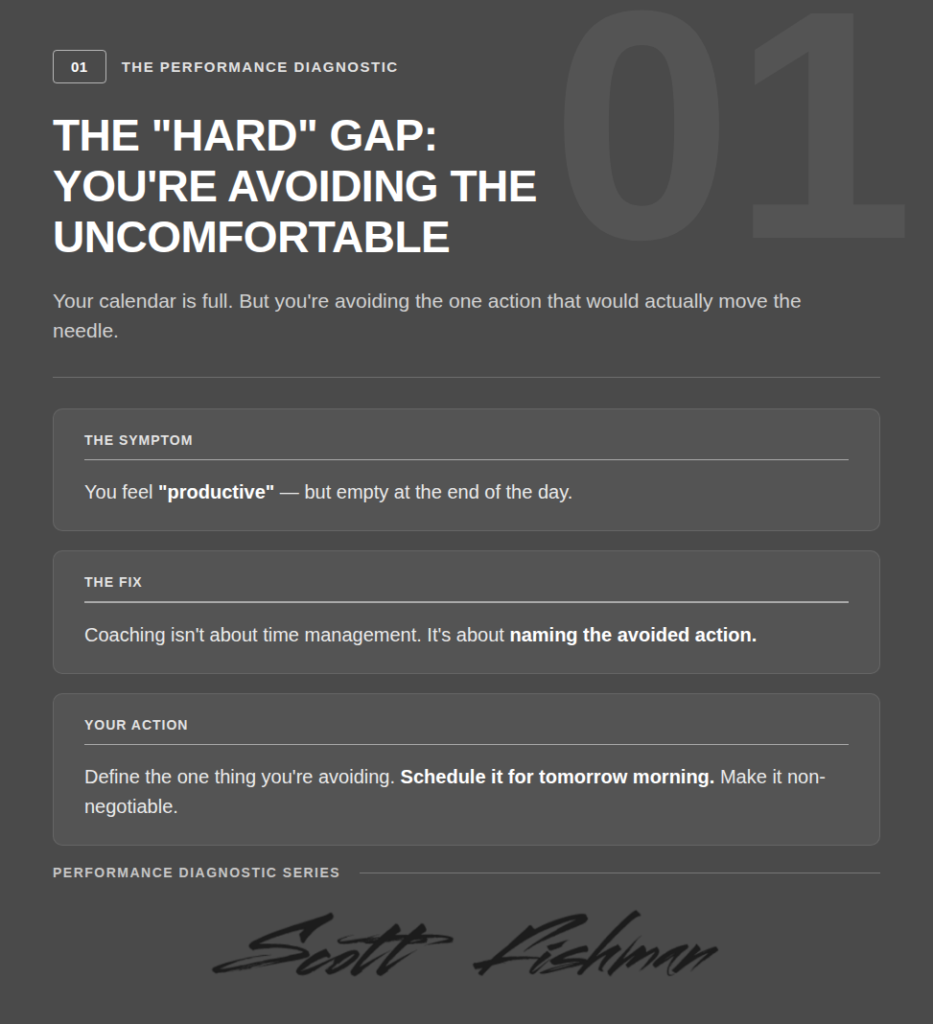
Is the effort here actually difficult, or does it just feel like a lot of activity? If the schedule is full but nothing genuinely uncomfortable is happening, that’s a Hard gap.
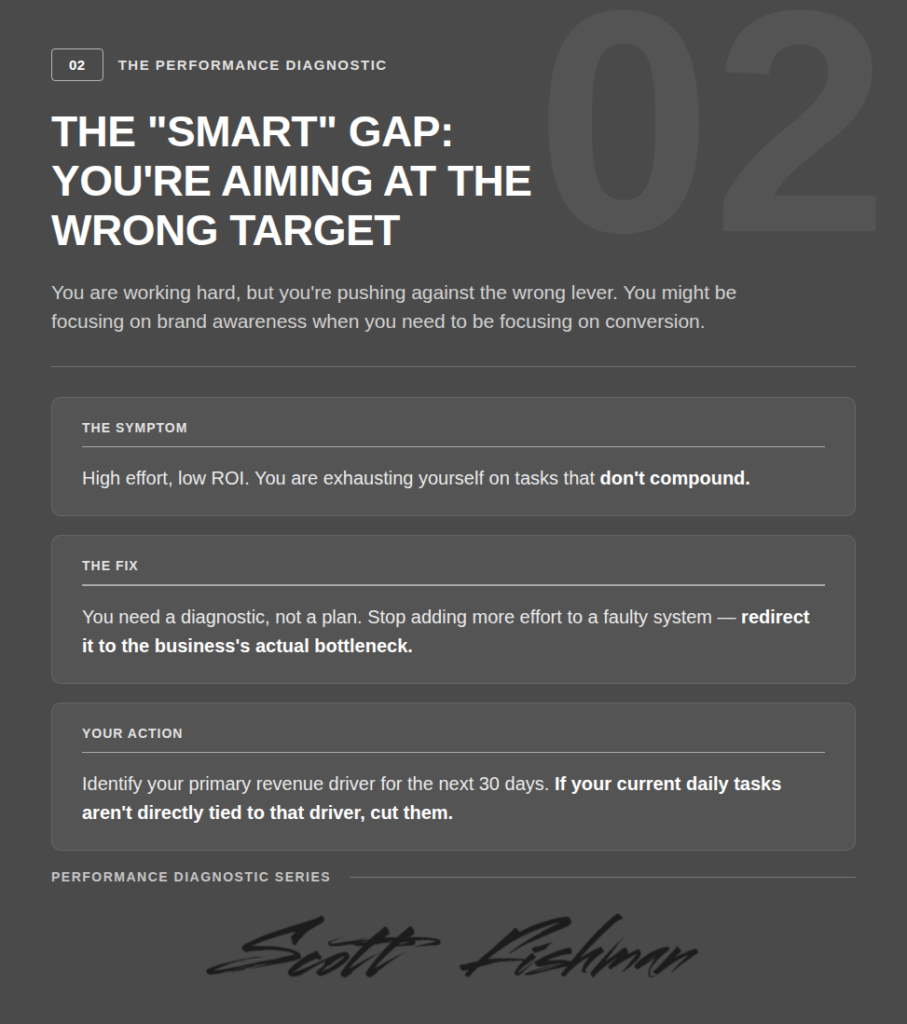
Is the hard work pointed at the right target? If real, sustained effort still isn’t producing results, check whether it’s aimed at what actually matters or just at what’s familiar. That’s a Smart gap.
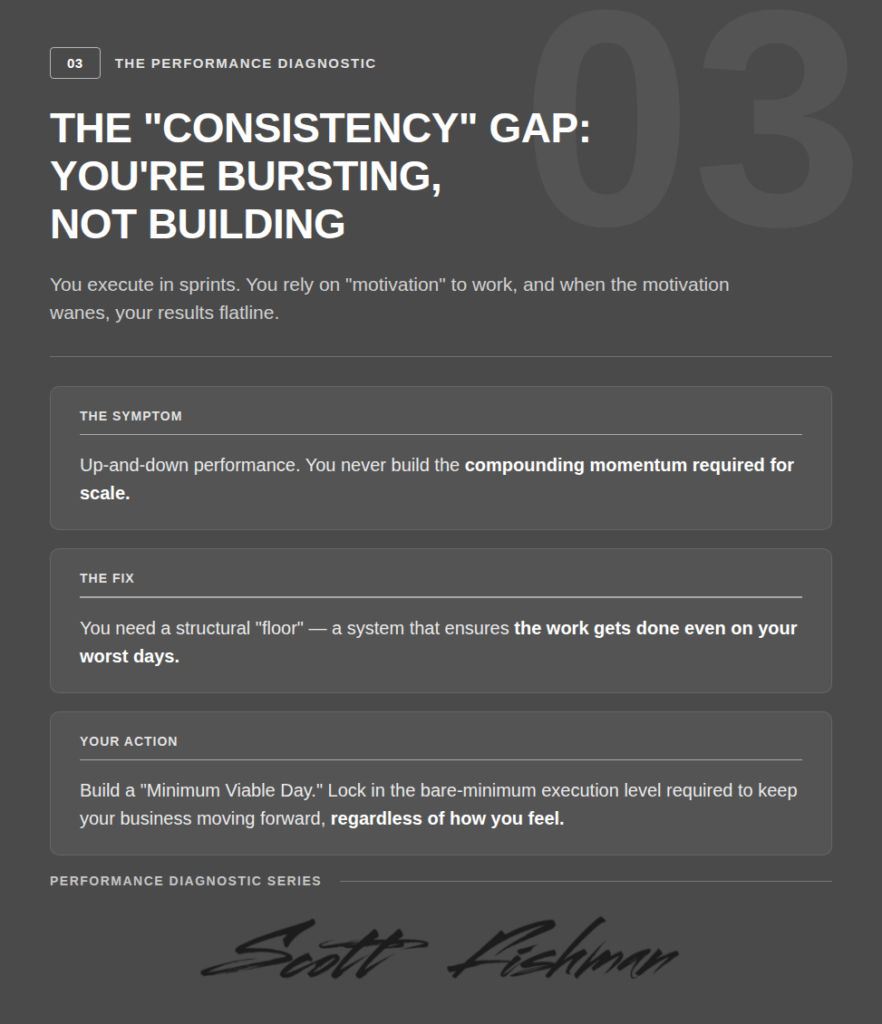
Is this happening every time, or only when it’s convenient? Look at the last month, not the last week. If the pattern only shows up in bursts, that’s a Consistency gap, and no amount of strategy fixes it until the pattern does.
Why the EFFORT Audit Is Hard to Run Alone
All three gaps feel identical from the inside, the same frustration of working hard and not seeing enough return. That’s exactly why an outside diagnostic, a coach, a framework, a second set of eyes, catches what self assessment alone tends to miss. Running the three questions honestly is a start. Having someone else run them with you is usually what actually surfaces the real answer.
If the exhaustion you’re diagnosing looks less like a stalled goal and more like genuine burnout, the same three questions still apply, just aimed at recovery instead of a plateau. See The Comeback Formula: EFFORT Applied to Recovery for that version of the diagnostic.
This is the same diagnostic I run with teams from the stage as a high-performance keynote speaker — Hard, Smart, Consistent, live, with a room instead of just a page.
Frequently Asked Questions
How long does it take to run the EFFORT audit?
A few honest minutes, if you’re willing to actually sit with the three questions instead of rushing to an answer that feels comfortable. The diagnostic itself is fast. The hard part is answering honestly, since all three gaps feel similar from the inside.
What if I think I have more than one gap at once?
Pick the one that’s most obviously true right now and fix that one first. Trying to fix all three simultaneously usually means none of them get fixed, because the plan gets diluted. Run the diagnostic again after the first fix lands, since closing one gap often makes the next one easier to see.
Should I run this alone, or with someone else?
Alone is a fine starting point, but a second set of eyes, a coach, a colleague, a framework, tends to catch what self assessment misses, precisely because all three gaps produce the same frustrated feeling from the inside.
What if I don’t even know what my number one goal is?
You’re not alone. On a first call, most people, 93% in Scott’s own experience, can’t clearly state their number one goal, and that number climbs to 98% for people specifically trying to lose weight. Naming the actual goal, precisely, is step zero, before any of the three questions can even be answered honestly.
Scott H. Fishman is the author of Effort. Scott earned a Bachelor of Education from the University of Miami and later studied Sports Psychology in grad school at the United States Sports Academy. Coach Scott Fishman has earned the top training certifications including CSCS from National Strength and Conditioning Association (NSCA) as well as certification from USA Track and Field (USATF), USA Weightlifting (USAW), USA Basketball (USAB), National Council on Strength and Fitness (NCSF), and more. With 20 years of experience designing high-performance systems for professional athletes, teams and organizations, Scott Fishman is now a keynote speaker. Scott founded Team All-American, AllWorldU, and is the Chairperson of the Board at United Sports Association (U.S.A.). As an athlete, Scott played professional basketball for the Virginia Wolverines (EBA) and North Jersey Pros (EBA). He’s also a marathon runner. Scott is from New York originally and currently resides in the Greater Tampa Bay Area. Scott is the Executive Director of the St. Pete Marathon and the Director of Growth at Winsignia.
Related Reading
The EFFORT Framework: The Complete Guide to Hard, Smart, Consistent
High-Performance Leadership: The Scorecard Every Leader Needs
Why Your Team is Not Performing Well