Quick answer: Most business leaders think they have a strategy problem when the real issue is execution. The EFFORT diagnostic checks three gaps: Hard (avoiding the uncomfortable action), Smart (effort aimed at the wrong target), and Consistent (bursts instead of a steady floor). Whichever one shows up is what to fix first.
- Key Takeaways
- Strategy is rarely the actual bottleneck for a stalled business, execution is, which is why the fix is a diagnostic, not a new plan.
- A Hard gap looks like a full calendar with the one needle-moving action still being avoided.
- A Smart gap looks like high effort and low ROI, real work pointed at a lever that was never going to move the business.
- A Consistency gap looks like bursts of great weeks followed by stagnant ones, with results flatlining once motivation fades.
Most business leaders think they have a strategy problem. They buy the courses, hire the consultants, and refine their funnels—yet, the needle refuses to move.
After twenty years of coaching elite athletes and business leaders, I’ve learned the truth: Strategy is rarely the bottleneck. Execution is.
If you are working 60-hour weeks but aren’t hitting your targets, you don’t need a new strategy. You have a Performance Gap.
In my coaching practice at Winsignia, I use a simple, three-part diagnostic to identify exactly where a leader is breaking down. I call it the EFFORT Framework. This is the diagnostic at the center of my performance consulting work with business leaders.
You can use my scorecard to diagnose your own performance today.
The High-Performance Leadership Scorecard: Where Are You Failing?
Look at your current biggest business challenge and identify which of these three buckets it falls into.
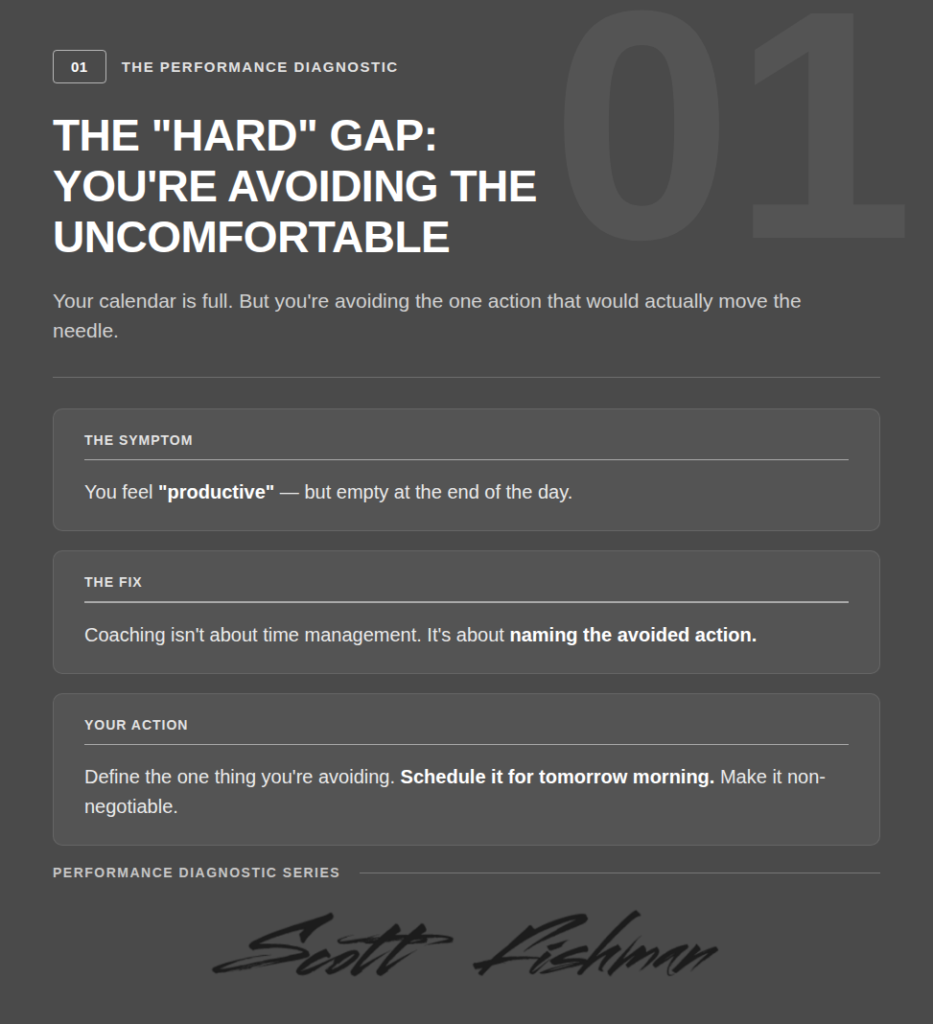
1. The “Hard” Gap: You’re Avoiding the Uncomfortable
You are busy. Your calendar is full. But you are avoiding the one action—the uncomfortable sales call, the difficult conversation with a teammate, the launch of a new offer—that would actually move the needle.
- The Symptom: You feel “productive” but empty at the end of the day.
- The Fix: Performance coaching isn’t about time management; it’s about naming the avoided action.
- Your Action: What is the one thing you are currently avoiding that you know you need to do to hit your Q3 goal? Define it, schedule it for tomorrow morning, and make it non-negotiable.
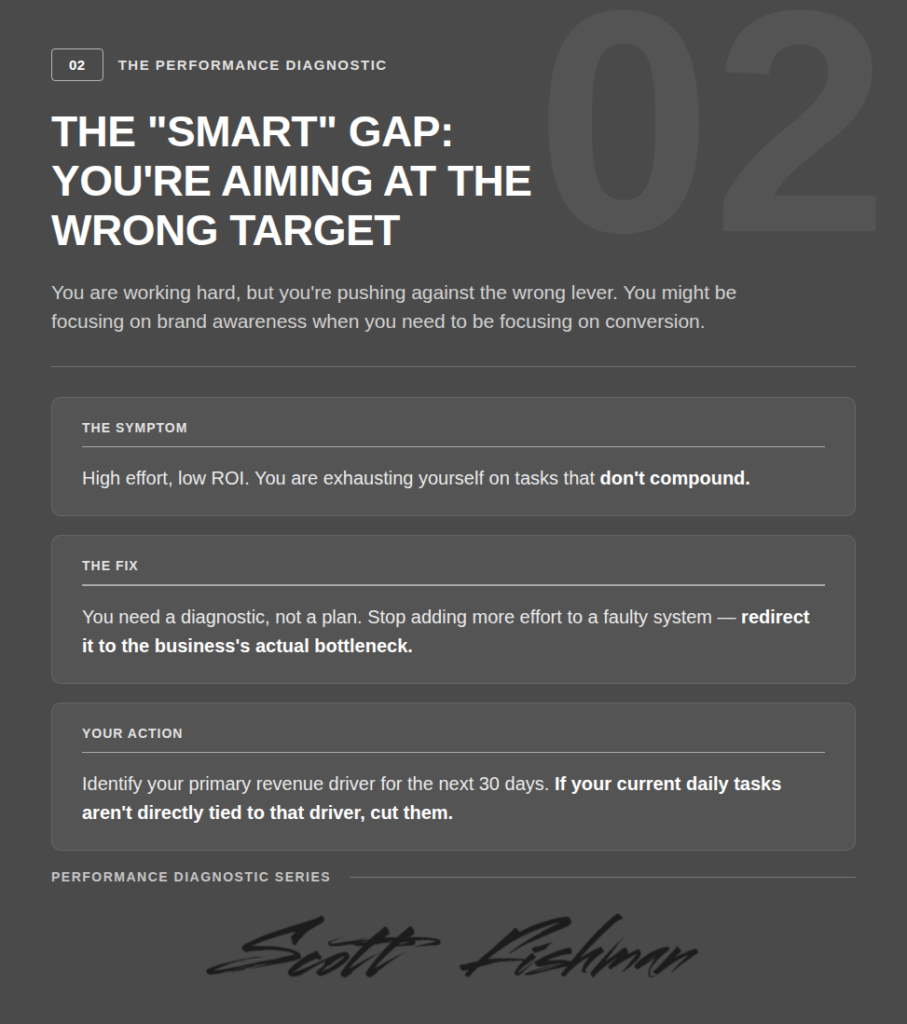
2. The “Smart” Gap: You’re Aiming at the Wrong Target
You are working hard, but you’re pushing against the wrong lever. You might be focusing on brand awareness when you need to be focusing on conversion, or hiring more staff when you need to be refining your offer.
- The Symptom: High effort, low ROI. You are exhausting yourself on tasks that don’t compound.
- The Fix: You need a diagnostic, not a plan. Stop adding more effort to a faulty system. Redirect your current effort to the business’s actual bottleneck.
- Your Action: Identify your primary revenue driver for the next 30 days. If your current daily tasks aren’t directly tied to that driver, cut them.
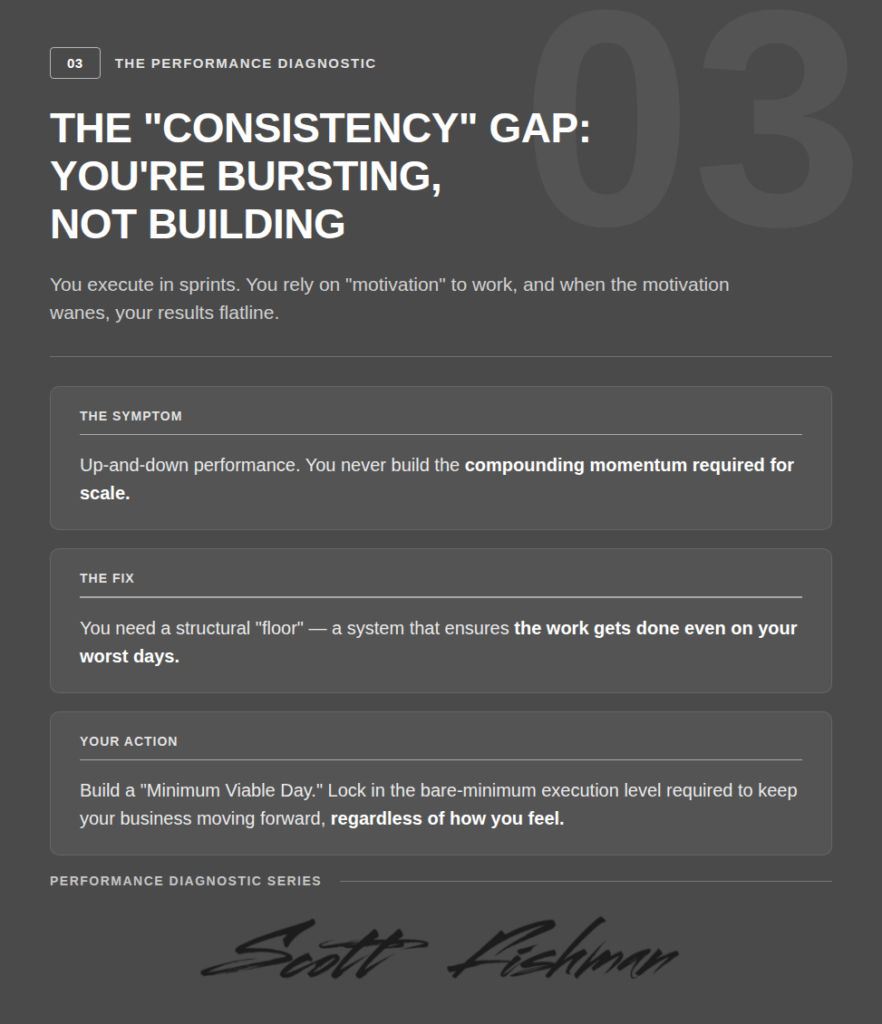
3. The “Consistency” Gap: You’re Bursting, Not Building
You execute in sprints. You have a great week followed by a stagnant one. You rely on “motivation” to work, and when the motivation wanes, your results flatline.
- The Symptom: Up-and-down performance. You never build the compounding momentum required for scale.
- The Fix: You need a structural “floor.” You need a system that ensures the work gets done even on your worst days.
- Your Action: Build a “Minimum Viable Day.” What is the absolute, bare-minimum execution level required to keep your business moving forward? Lock that in as your floor, regardless of how you feel.
What High-Performance Leadership Actually Looks Like
A leader can usually build a strategy. What is nearly impossible to do alone is to see your own blind spots in real time.
When you’re inside the game, a “Hard” problem feels exactly like a “Smart” problem: just pure frustration.
I don’t offer generic consulting. I provide the same high-performance diagnostics I used to get athletes to the podium, applied to your business. We don’t just plan; we diagnose, we isolate the gap, and we execute until the scoreboard changes. This is the same diagnostic I bring to a room as a high-performance keynote speaker when I work with a leadership team live.
Ready to audit your performance?
- Book a Strategy Session — Let’s look at your current bottleneck and diagnose the fix.
- Hire Scott to Speak — Bring the EFFORT framework to your next corporate event or leadership summit.
Frequently Asked Questions
How do I know if my business problem is strategy or execution?
If you’re working long hours and still not hitting targets, it’s almost always execution, not strategy. Run the three-part diagnostic, Hard, Smart, Consistent, against your current biggest bottleneck before buying another course or hiring another consultant to refine the plan itself.
Can I run this scorecard on my own business without a coach?
Yes, as a starting point. But a Hard problem and a Smart problem both feel like pure frustration from the inside, which is why a leader can usually build a strategy alone but rarely sees their own blind spot alone. An outside diagnostic tends to isolate the real gap faster.
What’s a “Minimum Viable Day” and why does it fix a Consistency gap?
It’s the bare minimum execution level that keeps the business moving forward regardless of how you feel that day. Consistency gaps come from relying on motivation to work, and motivation is unreliable by design, so locking in a floor that holds on the worst days is what actually fixes it.
Related Reading
The EFFORT Framework: The Complete Guide to Hard, Smart, Consistent
Why Your Team Is Not Performing Well
Building a Championship Culture at Work
Sports Psychology for Athletes (and CEOs)
Scott H. Fishman is the author of Effort. Scott earned a Bachelor of Education from the University of Miami and later studied Sports Psychology in grad school at the United States Sports Academy. Coach Scott Fishman has earned the top training certifications including CSCS from National Strength and Conditioning Association (NSCA) as well as certification from USA Track and Field (USATF), USA Weightlifting (USAW), USA Basketball (USAB), National Council on Strength and Fitness (NCSF), and more. With 20 years of experience designing high-performance systems for professional athletes, teams and organizations, Scott Fishman is now a keynote speaker. Scott founded Team All-American, AllWorldU, and is the Chairperson of the Board at United Sports Association (U.S.A.). As an athlete, Scott played professional basketball for the Virginia Wolverines (EBA) and North Jersey Pros (EBA). He’s also a marathon runner. Scott is from New York originally and currently resides in the Greater Tampa Bay Area. Scott is the Executive Director of the St. Pete Marathon and the Director of Growth at Winsignia.